

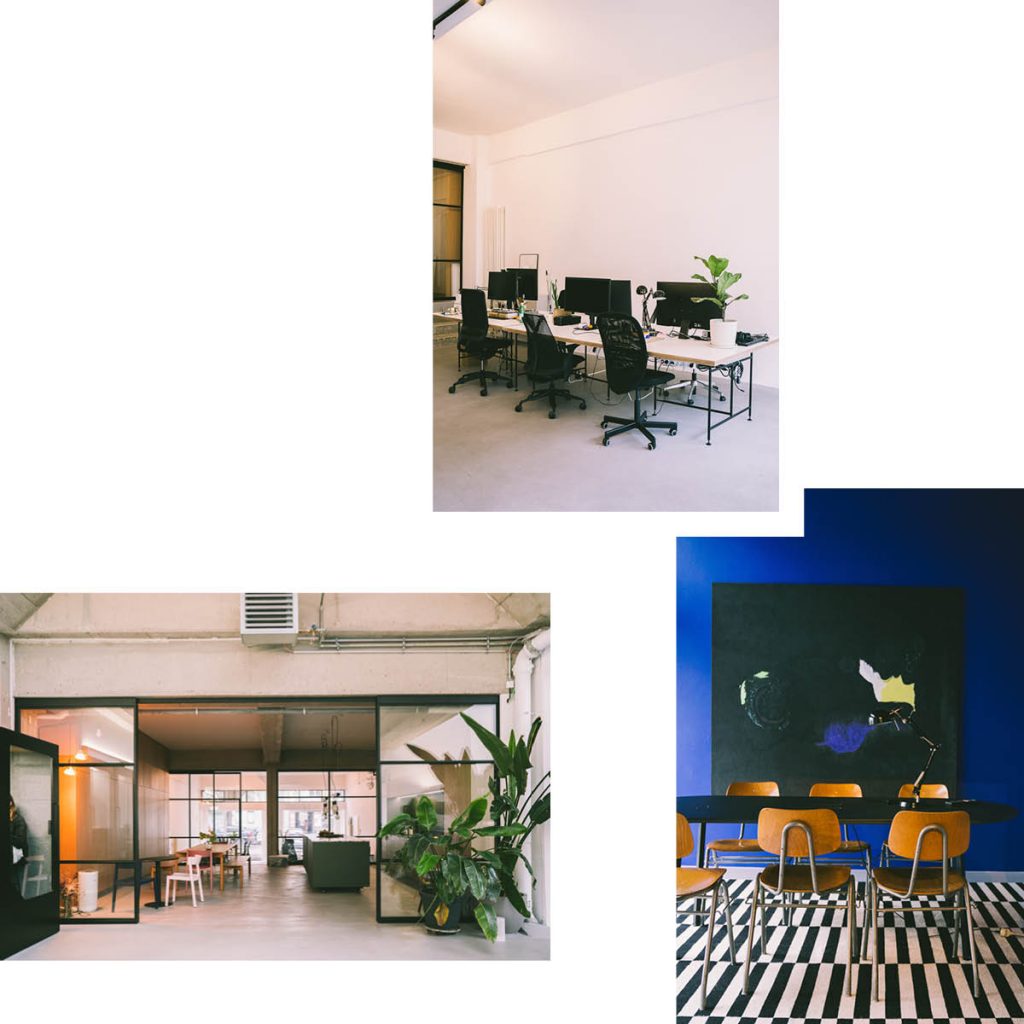
Everything is new in January: we are reorganizing and rethinking our space. That’s why we not only offer free office desks (see also the article here), but also a whole room for a small company: The lower part of our space is now also available. The bright room with floor-to-ceiling windows has its own entrance and street-side access, meaning you could also set up a small showroom with its own meeting room on request. There’s soundproof booths for meetings and a kitchen – both of which are shared with the rest of the studio. Analog amenities such as Third Wave Coffee, Leogant-filtered water and printer are included. Of course you also profit from digital amenities too, such as a meeting room booking system, a digital lock at the main entrance and obviously: good internet. We are looking for a company of up to eight people or two small groups/collectives/companies for the bright room on Charlottenstrasse. If that sounds exciting, please get in touch with us by email. And with a bit of luck, individual spaces are still available in the Cee Cee Studio. Viewings are possible at any time – Cee Cee you later.
Text: Nina Trippel / Photos: Robyn Steffen
Cee Cee Studio, Charlottenstr.1, 10969 Berlin–Kreuzberg; map
Price for single desks: 380€/pP. Price for the office room incl. meeting room: 3500€/month.
@ceeceecreative
@ceeceeberlin