


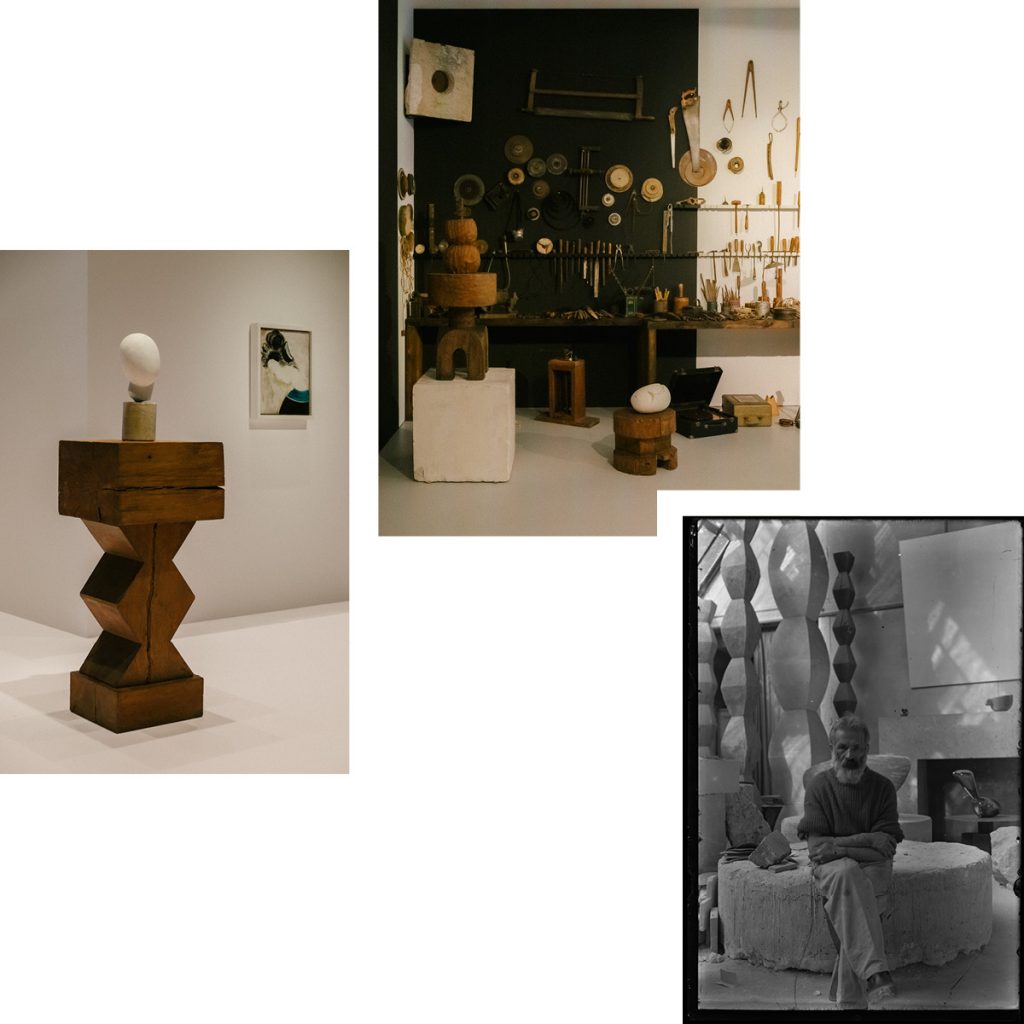
You get to know an artist best at their studio. In the case of the sculptor Constantin Brancusi, Berliners now have a rare opportunity to visit his studio in a partial reconstruction. Nearly seventy years after the death of this groundbreaking Romanian artist, the Neue Nationalgalerie is bringing his work to Berlin. In collaboration with Paris’s Centre Pompidou(under renovation until 2030), key works, furniture, and tools are on display in this exhibition. In Berlin, 150 works by the artist demonstrate how he freed himself from naturalistic form and gradually transformed sculpture into a play of light and movement. Brancusi, who came from a village near the Romanian Carpathians, began his training at the Academy of Fine Arts in Bucharest. After that, there was only one goal: Paris, the center of the avant-garde. He is said to have set out on foot from Bucharest to Montmartre, where he formed friendships with leading figures of modernism, including Henri Matisse, Fernand Léger, and Marcel Duchamp.
His career was also on the rise. He secured a position as Auguste Rodin’s assistant, the most famous sculptor of the time. Although he did not remain in Rodin’s studio for long, Rodin helped set Brancusi on the path toward abstraction. His innovative techniques, fragmentation, and dynamism influenced the young Romanian artist. Some of Brancusi’s most important works refer directly to his mentor, including “The Kiss”, which is considered a direct response to Rodin’s marble sculpture of the same title. Brancusi quickly developed his own style: polished surfaces, the pedestal as part of the sculpture, and reduced forms. Without Brancusi, art would have arrived less quickly and less directly to where it stands today. Influential minimalists such as Isamu Noguchi, Donald Judd, and Dan Flavin owe a great deal to him. But Brancusi also set new standards in architecture and design. On his first visit to New York in 1926, he is said to have exclaimed at the sight of the skyscrapers: “That’s my studio!” He was not entirely wrong. Even today, these soaring buildings retain something sculptural. Norman Foster and Jean Nouvel agreed. They named some of their most famous architectural projects in homage to the artist who, even as a young man, aimed high.
Text: Laura Storfner / Photos: Constantin Brancusi, Sophie Doering / Credit: Centre Pompidou, MNAM-CCI/Dist. GrandPalaisRmn, Succession Brancusi, VG Bild-Kunst, Bonn 2026
Neue Nationalgalerie, Potsdamer Str.50, 10785 Berlin–Tiergarten; map
Brancusi 20.03.–09.08.2026
@neuenationalgalerie
