
Cee Cee Creative Newsletter Book Neighborhood Map Lessons
Stadtplan
Information
archive temp
loop temp
“IRGENDETWAS IST PASSIERT”: A PLAY BY & WITH FABIAN HINRICHS — RECOMMENDED BY ANTJE DRINKUTH

“IRGENDETWAS IST PASSIERT”: A PLAY BY & WITH FABIAN HINRICHS — RECOMMENDED BY ANTJE DRINKUTH

Irgendetwas ist passiert is a new play by and starring Fabian Hinrichs at the Berliner Volksbühne. The seemingly casual title captures exactly what the play explores: the feeling that the world has gone off its hinges, even as everyday life continues as normal. Hinrichs stands alone on stage, performing dual roles as the couple Claudia and Paul in a rapid back-and-forth. Their dialogues oscillate between separation and closeness, despair and banal intimacy. When Paul, after an argument, suggests watching the news together and offers a massage, it encapsulates the ambivalence of a relationship that was once rooted in deep love, formed on that evening when a reactor exploded in Fukushima. Global history and private biography are intertwined from the very beginning. This connection runs throughout the evening. Hinrichs plays with his characteristic nervous, intelligent, and self-ironic precision. He indicts life, love, and political madness, teetering between attack and surrender. While arguments unfold in a minimalist suburban home over salad or an overpriced kitchen countertop, war sounds, news fragments, and images of violence intrude through sound and projection.

Claudia withdraws, watches pornography, and then the focus shifts again to the war in Ukraine and Israel’s violence in Gaza. Before going to bed, American Psycho plays, immediately followed by images of destroyed cities. The urge to smash the TV becomes the cry of a generation that is permanently informed yet simultaneously powerless. The relentless juxtaposition of bourgeois comfort and global catastrophe pushes the play to its moral limit. Luxury advertisements flicker across the screen, private dialogues and political abysses collide. Anger, overwhelm, and quiet moments alternate. Dramaturgy and technical design are so finely balanced that not a single moment of the ninety-minute performance feels dull. Memories of the Pollesch solo evenings are unmistakable, most recently Ja nichts ist ok. Yet Hinrichs goes a step further. Created with his wife, Anne Hinrichs, the piece is radically personal, focusing on the existential doubts of a relationship amid multiple crises. Critics’ accusations of melodrama and moralizing were to be expected. But its immediacy strikes a raw nerve: informed, overwhelmed, privately entangled, politically paralyzed. A theater evening that hurts, is intelligent, and lingers long after. Go see it!

Text: Antje Drinkuth / Photos: Apollonia Theresa Bitzan

Antje Drinkuth is a professor of fashion design and has lived in Berlin since 1987.

Volksbühne am Rosa-Luxemburg-Platz, Linienstr. 227, 10178 Berlin–Mitte; map

Irgendetwas ist passiert by Fabian Hinrichs & Anne Hinrichs, 08. & 15.02. (sold out), 14. & 22.03.2026. Get tickets here.

@volksbuehne_berlin
@antje_drinkuth

cee_cee_logo
DER KLEINE AUGUST: A BUZZING NEW CORNER FOR FRENCH WINE IN MITTE — RECOMMENDED BY FIONA LAUGHTON

DER KLEINE AUGUST: A BUZZING NEW CORNER FOR FRENCH WINE IN MITTE — RECOMMENDED BY FIONA LAUGHTON

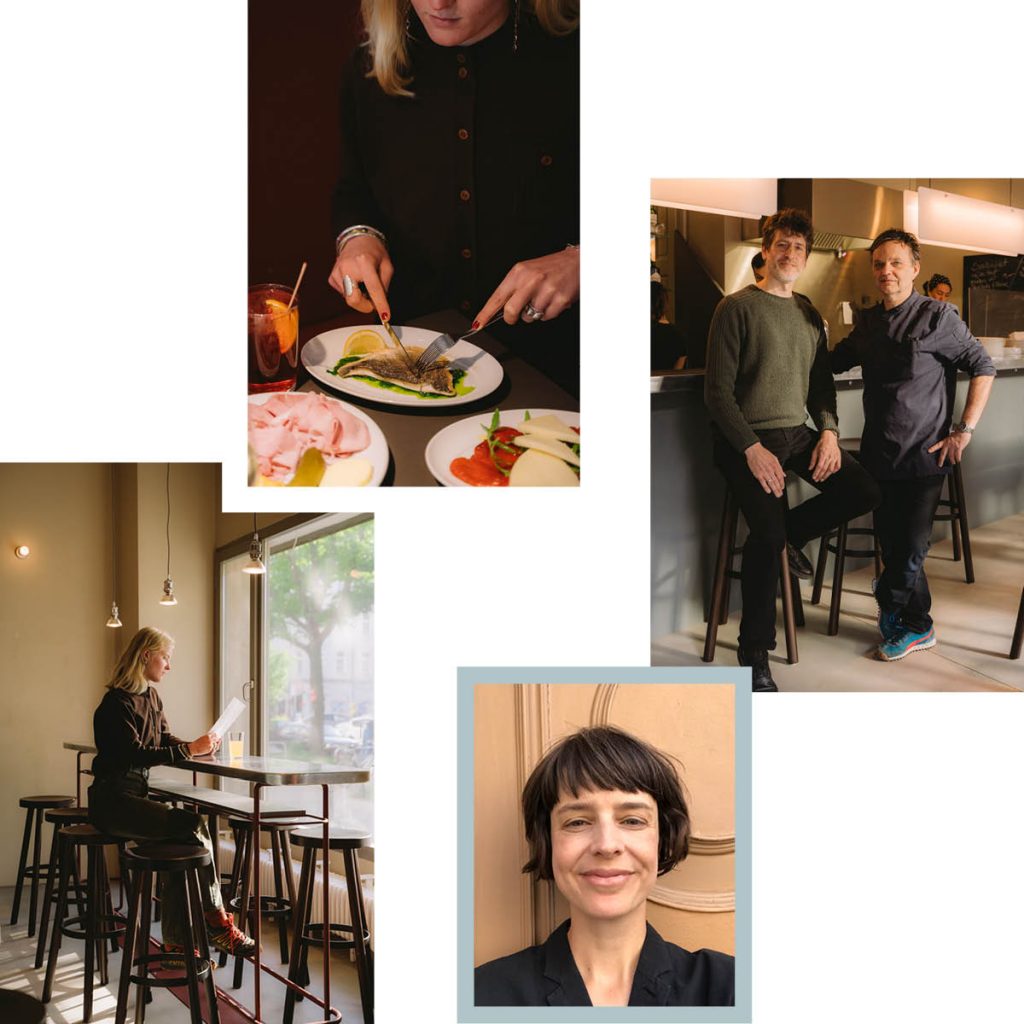
Some discoveries feel distinctly Berlin: a quiet, gallery-lined street; a soft glow through the window on Mitte’s Auguststraße that carries a sense of instant belonging. Warm, unpretentious, and humming with energy, Der Kleine August is the kind of bar that invites you in — and convinces you to stay. The interior leans understated: textured surfaces, gentle lighting, shelves of French bottles that hint at depth rather than put it on display. The team, in their bleu de travail jackets, sets the tone quickly — welcoming, attentive, unfussy. Even in its early days, the bar operates with a natural ease. French wine culture is the anchor here, but without formality. The staff translates a thoughtful wine list into accessible, lively conversation. Whether you’re a casual drinker or deep into terroir talk, you’ll find a way in. The selection feels curated for character, not trends. Small plates keep pace: charcuterie sliced to order, cheeses chosen with intention, sardines by the tin—pairings that complement rather than compete. Everything encourages slow sipping, sharing, and, oops, staying longer than planned. What sets Der Kleine August apart is its mood — buzzing but calm, intimate without being insular. It sets the stage for first dates that fade into the background hum, friends huddled around tables, and solo guests who slip easily into the room’s rhythm. Grab a seat at the bar and witness a place that hosts as much as it serves. For anyone seeking a new wine bar in Mitte that balances quality with approachability, Der Kleine August lands confidently between the two. It’s a fresh addition to the neighborhood — and one that already feels here to stay.

Text: Fiona Laughton / Photos: Marie Staggat

Fiona Laughton is a Berlin-based strategist, writer, and founder of Present For The Future. Originally from Melbourne, Australia, she has been living in Berlin since 2013.

Der Kleine August, Auguststr.23, 10117 Berlin–Mitte; map

@derkleineaugust

cee_cee_logo
DISCOVER AUTHENTIC GEORGIAN CUISINE AT DAIA — RECOMMENDED BY NICOLE ERNST

DISCOVER AUTHENTIC GEORGIAN CUISINE AT DAIA — RECOMMENDED BY NICOLE ERNST

Tucked away in the midst of the Scandinavian quarter, between culinary household names Estelle, Omoni and Terese, a new addition was welcomed in October 2025: Daia. Sisters Tamuna and Tatia, along with Demna, set out to create a warm, hospitable atmosphere and a sense of family to share with their guests, along with authentic Georgian cuisine. Family is, after all, what comes first for the three. In their homeland of Georgia, cooking and sharing meals around the kitchen table is an expression of love and connection. And that’s exactly what they hope to pass on to their guests. Embracing this results in an atmosphere blending tradition and clarity. Soft, cave-like tones and cozy lighting contrast with a bright bar, a luminous island whose glass blocks radiate towards heavy wooden tables that have definitely witnessed quite a bit of life. The pièce de résistance is the open oven built by the team, which admittedly is highly Instagrammable, its neon signage announcing its purpose — in Georgian, of course. Transliterated into Latin script, it reads approximately “Sazkchobi”, “bakery”. Here, the Khachapuris are baked to perfection, buttery-soft from just four ingredients. Here you are cared for by people who truly know what they’re talking about.

Listing the full range of dishes would be a monumental task, but let it be known to the attentive guest that you can travel, often eating vegetarian or vegan, from east to west, north to south, through the culinary landscape of Georgia. The dishes are concise, deeply rooted in family tradition, and so distinctive in flavor that you simply have to try them all. A standout for me is Kharcho: a creation from the sisters’ grandmother, hailing from western Georgia. Historically, it was inspired by a roast in times of scarce meat. At Daia, it arrives on the plate as a crispy cauliflower dish. Served on a Georgian plate with a variety of walnuts. Walnuts are practically Georgia’s national snack, though they are less often eaten whole than turned into pastes and other preparations. Quality is evident in every choice, from ingredients to service. There is so much to discover and learn at Daia. Questions are welcomed with genuine enthusiasm. After all, who knew that Georgia has its own alphabet, has preserved its language and identity against countless invaders for centuries, and even invented wine? Indeed. From Pet Nat to orange wine, from traditionally buried amphora-aged vintages to the Tbilisi Sour, everything speaks one language: home, in the here and now. And so Tamuna and Tatia named their restaurant accordingly: Daia, “sister”. Because family is at the heart of everything they do. It is the core of the restaurant, the reason it exists. Daia is an invitation, offered sincerely and joyfully. And you feel it the moment you step inside.

Text: Nicole Ernst / Photos: Daia

Nicole Ernst has lived in the city for over 20 years. She is an actress who loves Berlin’s skies and everything that embodies style, beauty, and a certain sense of speed.

Daia, Kopenhagener Str.69, 10437 Berlin–Prenzlauer Berg; map

@daia_berlin

cee_cee_logo
GO RUNNING FOR HEARTS: A PROJECT BETWEEN FRIENDSHIP, LOSS AND THE SPIRIT OF MOVING FORWARD — RECOMMENDED BY MARIE WEZ

GO RUNNING FOR HEARTS: A PROJECT BETWEEN FRIENDSHIP, LOSS AND THE SPIRIT OF MOVING FORWARD — RECOMMENDED BY MARIE WEZ

In 2024, Go Miyazaki lost his close friend Robbie Dixon due to a rare condition causing heart failure. Riddled with grief and the deep pain of losing somebody close so suddenly, Go found the memory of his friend floating in tandem with his own emotions whenever he would run, leading him to alchemise both into Go Running for Hearts. “Losing him left a silence I didn’t know how to fill. Running is where I think and feel most deeply and I kept asking myself — How can I get through this? How can I turn this into something meaningful?” The project started raising funds, aiming to support heart disease research at the Victor Chang Cardiac Research Institute in Australia through both Go’s personal runs and additional donations. He wanted to not only keep his friend’s memory alive but also actively contribute to raising awareness and resources that could help prevent losses like Robbie’s. As the project gained momentum, Go decided to undertake Satisfy‘s Saddles100, a 160km ultra-marathon race through the desert in Arizona. “It was the hardest physical and mental challenge I’ve ever faced. There were moments where I questioned myself — moments of pain, moments where I felt complete emptiness, but also moments where I felt Robbie beside me, pushing me forward, reminding me why I started this journey. Crossing that finish line wasn’t just an achievement; it was a promise kept, a tribute fulfilled, and a moment I will carry with me forever.”

Go’s journey in Arizona has been documented by Berlin-based director Jack Hare and cinematographer Nela Wojaczkovaand is supported by Salomon and VooStore, where Go might be a familiar face for locals, working as Voo Deli’s head barista. It’s a moving story of friendship, grief, loss, community and the power of spirit. The documentary will be premiered on December 13 alongside an exhibition at VooSpace. “Go Running for Hearts” has so far raised over 5k Euro and is an ever-growing project. To donate and support Go’s mission, please find the project’s GoFundMe link here

Text: Marie Wez / Photos: Jack Hare

Marie Wez is a writer, poet and multi-disciplinary artist based in Berlin.

VooSpace, Oranienstr.24, 10999 Berlin–Kreuzberg; map
Go Running for Hearts – Charity Event 13.12.2025 11–19h. RSVP here.

@gomyzk
@jack_hare
@nwjczk
@lumaitland
@voostore
@salomon.dach
@s246.co
@saddles100
@satisfyrunning

cee_cee_logo
CAFÉ RIBO: HOME TO THE HEARTIEST MAULTASCHEN IN TOWN — A RECOMMENDATION BY SASCHA SILBERSTEIN

CAFÉ RIBO: HOME TO THE HEARTIEST MAULTASCHEN IN TOWN — A RECOMMENDATION BY SASCHA SILBERSTEIN

At Café Ribo, a lunch bistro on Ackerstraße, owner Katja has been preparing Maultaschen according to her mother’s recipe since 2009. In the summer of 2015, I tasted Swabian Maultaschen in broth for the first time. My partner at the time, Micha, ordered a Weißwurst, and we shared a salad with a dressing so delicious that I still try to recreate it today. The flavor instantly sparked a feeling of nostalgia, even though I’m from East Berlin and he’s from Bavaria. Here, feel the personal touch and presence of the owner and her family. Katja’s mother washes and irons the white tablecloths every day, while her father helps out behind the counter. In winter, when you enter, other guests briefly look up in acknowledgment before returning to their conspiratorial conversations. Over a plate of Spätzle, people tell each other how they’re really doing. In summer, the spacious terrace opens onto a public green space. Sit under trees, sip Orangina, play table tennis, and occasionally, there are even oysters in the evening. When I later learn about the Ribo choir, it becomes clear: beyond its fantastic Maultaschen, Ribo has long been a way of life for many. A kind of club that takes care of its members and where people genuinely enjoy growing older together.

Text: Sascha Silberstein / Photos: Ruby Watt

Sascha is from Berlin, Prenzlauer Berg. During the warmer months, she runs another welcoming place: the Wassermühle Nebeltal in Mecklenburg. In winter, she works as a cook for and with Vadim Otto Ursus (OttoTrioPluto).

Café Ribo, Ackerstr.157, 10115 Berlin–Mitte; map

@caferibo

cee_cee_logo