
Cee Cee Creative Newsletter Book Neighborhood Map Lessons
Stadtplan
Information
archive temp
loop temp
LAKOU, ZEMI & THE CONTINUING IMPACT OF HISTORY — BWA KAYIMAN AT HKW

LAKOU, ZEMI & THE CONTINUING IMPACT OF HISTORY — BWA KAYIMAN AT HKW

Lakou is Haitian Creole, which means a piece of land. Or a small yard, but above all, a place where all the important aspects of living together take place. And it’s, in its etymological origin, the subtitle of this year’s Bwa Kayiman festival at the HKW. The festival is in its third year, once again offering a packed program of performances, rituals, discussions, poetry, music, food, film, and installations. It’s about sovereignty: as a conscious examination of forms of resistance, belonging, memory, and transmission. This includes performances such as Plidetwal – Rain of Stars, a poetic assembly in Haitian Creole and French (with simultaneous translation in parts). Or Tongue and Throat Memories, part of an ongoing series at the HKW that links food, memory, and identity. On August 1, chef Craig Wong invites visitors to Food Offerings in the Lili Elbe Garden with Patois Gathering from Asia to the Caribbean — creating a culinary connection to his Jamaican-Chinese heritage. None of the contributions will be concentrated on one stage, but spread throughout the building and deliberately designed to be open. Zemí is a word from the Taíno language and describes a form of spiritual presence that can manifest itself in objects, landscapes, ancestors, or gestures. This is precisely what Bwa Kayiman wants: to understand history as something that is not complete, but continues to have an effect in everyday life.

Text: Inga Krumme / Credits: Vibrations, Translations, Slim Soledad, 2023, Photo: Mayra Wallraff; Patois Toronto; Studio Bowe

Haus der Kulturen der Welt (HKW), John-Foster-Dulles-Allee 10, 10557 Berlin–Tiergarten; map
Bwa Kayiman – Lakouzémi 01.–03.08.2025. Find the full program here.

@hkw_berlin

cee_cee_logo
DREAMS ON PAPER — ARCHITECTURE IN THE GDR

DREAMS ON PAPER — ARCHITECTURE IN THE GDR

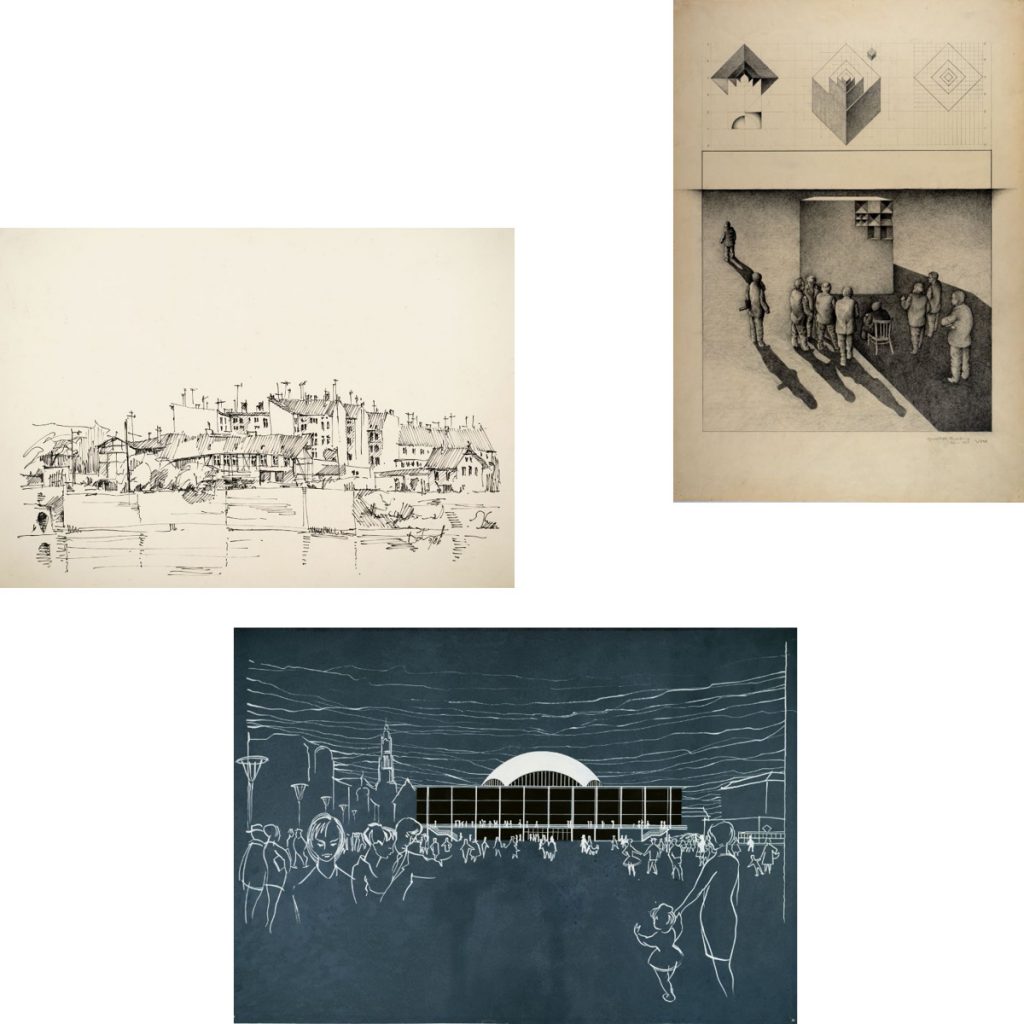
Think you already know everything about architecture in the GDR — prefabricated housing, standard types, functionalism? This exhibition might surprise you. Plans and Dreams – Drawn in the GDR at the Tchoban Foundation doesn’t focus on the finished buildings, but on the process behind them: more design than outcome, more vision than construction. With over 140 sketches, collages, and drawings, the show traces four decades of architectural work, highlighting the people and ideas that shaped it. For anyone interested in architecture, this is a chance to dive into built history and the struggle for creative freedom that often accompanied it. Alongside official project plans, you’ll find private, personal works: visual spaces for hope, reinvention, and occasionally resignation.

Featured are works by students from Dresden, Weimar, and Berlin, who entered the profession full of ambition and had to navigate the realities of a cost-optimized, standardized system. The material is drawn from the collection of the Leibniz Institute for Spatial Social Research (IRS) in Erkner. And enriched by loans from the Berlinische Galerie, the Leipzig City Archive, the Archive of Modernism at Bauhaus University Weimar, and private collections. An exhibition not only for those who think, draw, and build architecture, but for anyone who wants to see the urban fabric of Berlin in a new light.

Text: Milena Kalojanov / Credit: Michael Voll, Wolfgang Wähnelt; Leopold Wiel, Entwurfskollektiv Wiel mit Klaus Wever, Grafik Angela Waltz, Stiftung Sächsischer Architekten, Stadtarchiv Dresden, Nachlass Leopold Wiel

Tchoban Foundation, Christinenstr.18a, 10119 Berlin–Mitte; map
Plans and Dreams – Drawn in the GDR” until 07.09.2025

@tchoban_foundation

cee_cee_logo
TWELVE NIGHTS TO DANCE THE NIGHT AWAY — “DURCHLÜFTEN” BRINGS A BREATH OF FRESH MUSICAL AIR TO THE HUMBOLDT FORUM

TWELVE NIGHTS TO DANCE THE NIGHT AWAY — “DURCHLÜFTEN” BRINGS A BREATH OF FRESH MUSICAL AIR TO THE HUMBOLDT FORUM

What began in 2021 has long been an integral part of the Mitte summer. Durchlüften, the open-air music festival in the Schlüterhof of the Humboldt Forum, is entering its fifth round and will once again bring fresh air and new sounds to the heart of the city. Over four weekends (17.07.-09.08.2025), Thursdays to Saturdays, 24 live acts and 12 DJs from all over the world will transform the historic courtyard into a vibrating sound space. The musical program is a cross-genre festival — easy to dance to, deeply rooted, and open to all. Admission? Free of charge. The festival is curated by music expert Melissa Perales, who is again creating a stage for artists from Africa, South America, and Asia, and for sounds that speak to identity, exile, decolonization, cultural transmission, and community. Odd Okoddo (Kenya/Germany), for example, combines “Dodo Blues” with the rhythms of Sven Kacirek; and Jeano Elong (Cameroon/Germany) brings the dance of the Mkoum to the stage as part of his musical escape story.

More highlights include the Minyo Crusaders (Japan/Colombia) fusing Japanese folk songs with Cumbia. Charif Megarbane lets his sound wander between Beirut, Nairobi, and Lisbon. And duo, Ibelisse Guardia Ferragutti & Frank Rosaly, bring together Brazilian, Bolivian, and Puerto Rican influences to create a musical experience between resistance and ritual. Aeration creates space for encounters, for exchange, for stories. For music that grows out of the realities of its makers. Come along, listen, and dance the night away. 

Text: Leo Sandmann / Photos: Frank Sperling, Lucho Vildales, Yukitaka Amemiya

Schlüterhof of the Humboldt Forum, Schloßplatz, 10178 Berlin–Mitte; map
Durchlüften 17.07.–09.08.2025, every Thursday–Saturday (free admission).

@humboldtforum

cee_cee_logo
ON THE TRAIL OF MODERNISM: THE JEWISH MUSEUM BERLIN REMEMBERS FORGOTTEN FEMALE DESIGNERS

ON THE TRAIL OF MODERNISM: THE JEWISH MUSEUM BERLIN REMEMBERS FORGOTTEN FEMALE DESIGNERS

What connects Friedl Dicker and Maria Luiko? Both were successful Jewish female artists among the most respected talents of the 1920s and 1930s. Dicker was born in Vienna and studied at the Bauhaus in Weimar before making a name for herself as an interior designer. Luiko came from Munich and regularly exhibited there as an artist. Her work was diverse — she illustrated books for writer Ernst Toller and designed theater puppets. Today, their work is known to few. Their lives and careers came to an end at the hands of the National Socialists. Dicker was murdered in the Auschwitz concentration camp, and Luiko in Fort IX in Kaunas. In a comprehensive group exhibition, the Jewish Museum Berlin commemorates the pair, along with over 60 other Jewish craftswomen, designers, and painters who paved the way for subsequent generations as pioneers in their disciplines.

Silversmith Emmy Roth was one of the first women in Germany to pass the master craftsman’s examination in the male-dominated field. Her tea and coffee pots are so elegant and minimalist that they could still be used in Berlin cafés today. Children’s book author and painter Tom Seidmann-Freud, niece of Sigmund Freud, was part of the dazzling artistic scene around the Romanisches Café in Charlottenburg and created fairy tales so expressionistically that they still inspire adults today. Curator Michal Friedlander traces their lives with an eye for detail and a wealth of knowledge. We get to know women who fought against social conventions, were politically active, and unwaveringly pursued their art and life dreams. In addition to well-known figures such as textile artist and Bauhaus teacher Anni Albers, it’s the women of the so-called “lost generation” who can be rediscovered today (10.07.) at 17h in the Jewish Museum Berlin to music by the Balagan Sisters. So that names like Friedl Dicker and Maria Luiko do not remain unknown in the future.

Text: Laura Storfner / Photos: Jens Ziehe / Credit: Emmy Roth, Kaffee- und Teeservice, Berlin 1931, Silber, getrieben; Horn; Jüdisches Museum Berlin, Inv.-Nr. 2010/143/0; Western Regional Archives, State Archives of North Carolina; Museum für Kunst und Gewerbe Hamburg

Jewish Museum Berlin, Lindenstr.9-14, 10969 Berlin-Kreuzberg: map

Defiance. Jewish Women and Design in the Modern Era” 11.07.–23.11.2025. Opening Thu 10.07. from 19h  (exhibition open from 17h), free admission on the opening night.

@juedischesmuseumberlin

cee_cee_logo
POWER, MORALITY & THE COLLAPSE OF A FAMILY — THE SEED OF THE SACRED FIG, NOW ON MUBI

POWER, MORALITY & THE COLLAPSE OF A FAMILY — THE SEED OF THE SACRED FIG, NOW ON MUBI

A film about power, morality, and family disintegration. Mohammad Rasoulof’s The Seed of the Sacred Fig portrays how political repression penetrates the very heart of society. Now and then, it overcomes me — usually creeping in in the morning, tightening its grip in the afternoon, and arriving in full force by evening — the longing for a truly great film. Anyone familiar with that feeling will know the small but nagging follow-up question: What should I watch? Lucky are those who have a Mubi subscription right now and haven’t yet seen Mohammad Rasoulof’s Oscar-nominated masterpiece The Seed of the Sacred Fig, which is currently available on the platform. Shot in utmost secrecy, the film tells the story of Iman (Missagh Zareh), a devout lawyer appointed as an investigating judge at the Revolutionary Court during the 2022 protests in Iran.

At first glance, it seems to be a promotion, but it quickly reveals a moral abyss. He is expected to sign off on death sentences without knowing the names or charges involved. While the “Women, Life, Freedom” movement gains strength outside, tensions rise within Iman’s family. His daughters, Rezvan (Mahsa Rostami) and Sana (Setareh Maleki), grow increasingly sympathetic to the protests, while his wife, Najmeh (Soheila Golestani), tries to hold the family together. When Iman’s service weapon goes missing, the already fragile family dynamic tips. Mistrust becomes suspicion. Control turns to violence. The family flees to the countryside, but even there, the pressure doesn’t ease. What unfolds is an intense chamber drama that exposes how authoritarian violence creeps into the most intimate spaces. Rasoulof uses deliberately sparse, powerful imagery to portray the inner disintegration of a man torn between power and guilt, faith and reality. The sacred fig symbolizes a regime whose roots reach into every aspect of life. The Seeds of the Sacred Fig captivates with outstanding performances and a keen visual sensibility. It’s real cinema and the perfect film for a cool summer night, when all you want is to sink into the sofa for three hours and let yourself be carried away by the sheer power of storytelling.

Text: Hilka Dirks / Stills: The Seed of the Sacred Fig

Mubi 

The Seed of the Sacred Fig Tree

You can try Mubi free for 30 days via this link.

@mubideutschland

cee_cee_logo