


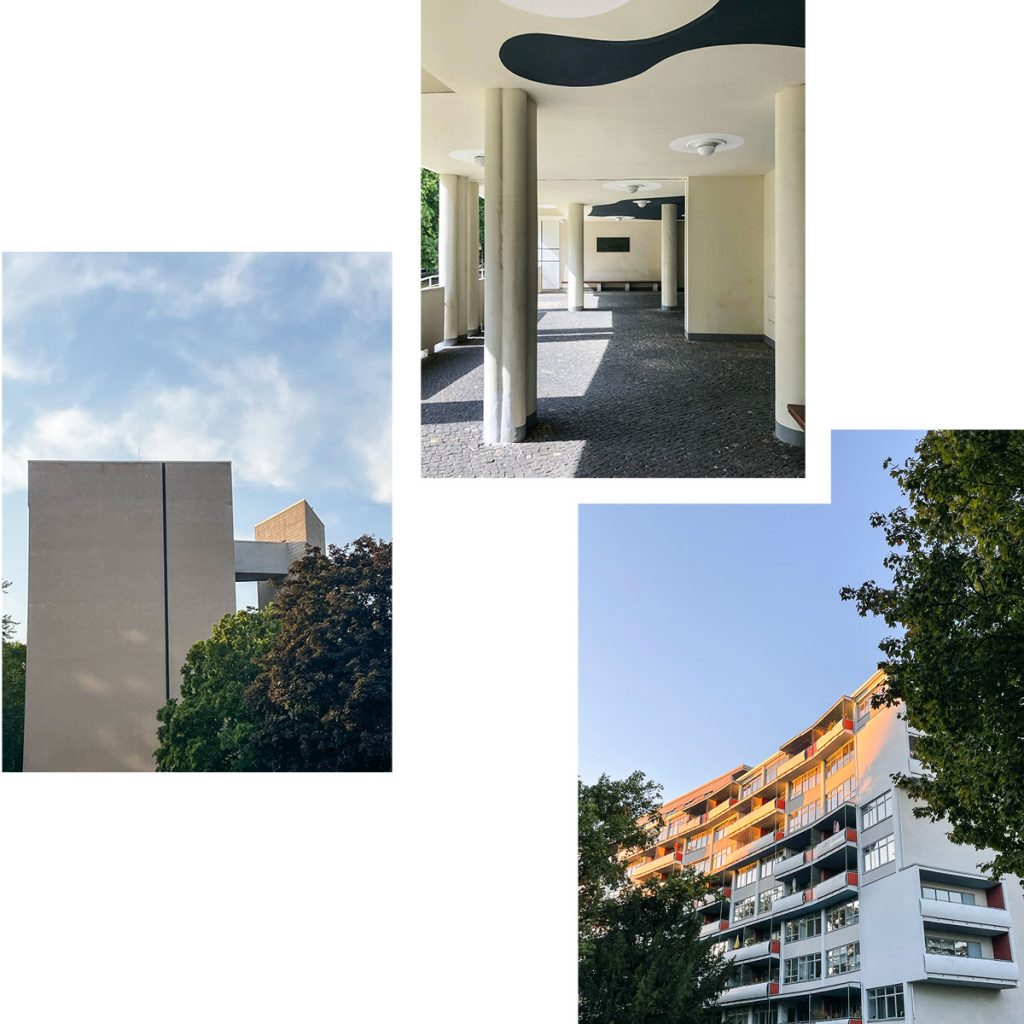
The Berlin district of Hansaviertel and I go way back. As a landscape architect, I know the area between the Großer Tiergarten and the Spree inside out, through every season. At least, I thought I already knew everything. Tours by Grotto, with architect Maria Helena (in English) or curator and café owner Leonie Herweg (in German) — an expert who lives and works there — proved me wrong. Before the Hansaviertel became what it is today, it was one of Berlin’s most sought-after bourgeois addresses. The cityscape at the time featured elegant boulevards, richly decorated façades and grand villas, and was home to historic sites such as Rosa Luxemburg’s first Berlin apartment and Käthe Kollwitz’s studio. It was also home to one of Berlin’s largest Jewish communities and two synagogues in pre-war Berlin. Three remaining historic buildings and the original street names still recall those past eras. After the Second World War, the area became the site of the 1957 International Building Exhibition, a model project for modern housing. The Interbau 1957 invited Walter Gropius, Oscar Niemeyer, Alvar Aalto, Werner Düttmann and around fifty visionary architects to design a city of tomorrow, positioned as a direct ideological counter-model to the monumental Karl-Marx-Allee (then Stalinallee), which was built in the eastern part of the city in 1951.
The Hansaviertel is composed of a range of architectural typologies: slab and point high-rises, linear housing blocks, special-purpose buildings and bungalows. Herta Hammerbacher, the only woman among the participants, designed the Hansaplatz — the heart of the district. We stroll past architectural jewels such as the Akademie der Künste, known not only for its striking façade but also as a hub for art and culture. Further west, set within the dense greenery of the Tiergarten, stand my favorite buildings: the Oscar Niemeyer House, the Eternithaus, the Alvar Aalto House and the Swedish House with the new Café Tiergarten, which Leonie has been running with her business partners since 2025. In the sunny garden of the Hansabibliothek, we enjoy the calm together with a few scattered readers. It’s the perfect retreat in the middle of the city’s bustle. Walking further west, we pass the bungalows by Sep Ruf and Arne Jacobsen. From the ruins emerged one of Berlin’s boldest urban experiments. The use of new materials, split-levels, flexible floor plans and generous glass façades defines the new residential buildings. The Hansaviertel remains a built utopia, and at the same time, a place where history resonates in every sightline. Anyone joining the tour with Leonie and Maria and paying close attention will discover, between concrete and greenery, the layered history of a city that is constantly reinventing itself.
Text: Milena Kalojanov / Photos: Grotto
Meeting point: Hansabibliothek, Altonaer Str.15, 10557 Berlin–Hansaviertel; map
Book the Hansaviertel tour here.
@grotto.berlin
