


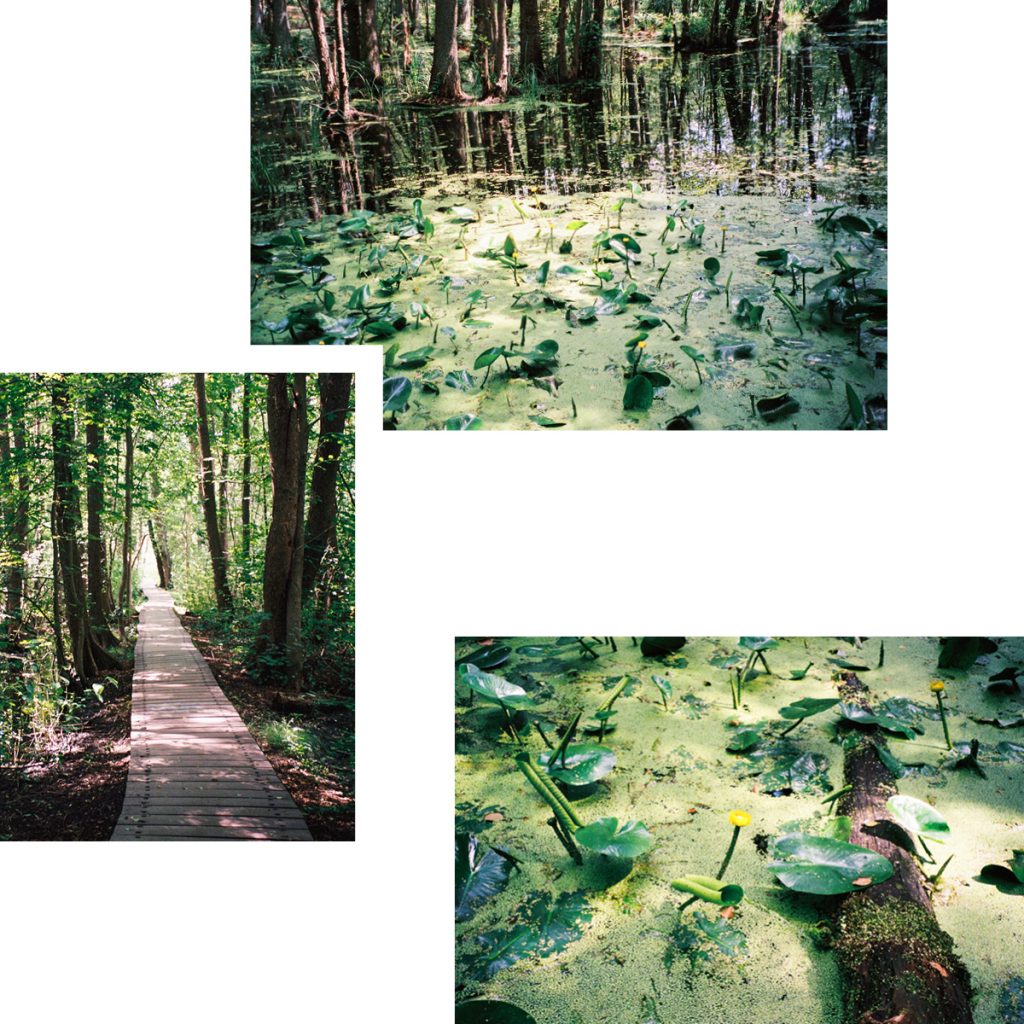
People sometimes think of moorlands as unfriendly, gloomy places that hold nothing good. However, the opposite is true: their peat bogs are fundamental for ecosystems and must be protected. Most moorlands were formed after the last ice age when the lack of oxygen in meltwater prevented plants from decomposing. This led to the formation of peat, which is used as fuel. Today, peatlands are home to large numbers of protected plants and animals and help mitigate global warming by serving as reservoirs for greenhouse gases. With this in mind, a trip to the Briese, a small tributary of the Havel river in Brandenburg, is all the more enjoyable. The starting point is Birkenwerder, which can be reached in half an hour on the S1 from Gesundbrunnen.
As you make your way out of Birkenwerder and its well-kept front gardens, you are greeted by an unspoilt landscape of green that runs alongside the river. There’s a lot to see, including water lilies, beaver dams, alder groves, swans and an endless number of dragonflies in blue and green. There is no need for detailed directions: just follow the river before crossing the bridge to the other side where you can see the whole spectacle from another perspective. Don’t forget to bring mosquito spray and make sure you stop and for a snack of blueberries plucked from the surrounding bushes. The whole walk is about 10 km, but you can make it longer by continuing on to one of the bridges further down.
Text & Photos: Laura Luisa Iriondo
