
Cee Cee Creative Newsletter Book Neighborhood Map Lessons
Stadtplan
Information
archive temp
loop temp
IN SPIRIT OF YOKO ONO: RINGING BELLS FOR PEACE AT THE NEUE NATIONALGALERIE

IN SPIRIT OF YOKO ONO: RINGING BELLS FOR PEACE AT THE NEUE NATIONALGALERIE

What does peace sound like? For artist Yoko Ono, it’s the interplay of bells swelling into a bright chorus. Throughout her life’s work, Ono has returned, again and again, to the theme of peace. As a young girl, she and her mother fled Tokyo during the Second World War; in the 1960s, she spoke out against the Vietnam War; and today she protests Russian aggression in Ukraine. Her performance, Bells for Peace, first presented in Manchester in 2019, is a moving call for peace and understanding. The participatory work recalls the ringing of bells on 11.11.1918, with the Armistice ending the First World War acoustically marked across Europe and the United States. This Sunday, at the closing event of her exhibition Dream Together at the Neue Nationalgalerie, Ono invites Berliners to join the ringing of bells and believe together in a better future.

Anyone who would like to join is invited to the museum terrace on 14.09.2025 at 16h45 to ring together for peace. At the 2019 premiere, 4,000 handcrafted ceramic bells (each engraved specially for the occasion) sounded, accompanied by the powerful resonance of a giant Buddhist bell and antique church bells. It’s best to bring your own bell or chime on Sunday, as few will be available at the Neue Nationalgalerie — but the museum will keep a supply ready so that Ono’s polyphonic chorus of bells can be heard across the Tiergarten. In times like these, it’s an act that feels especially fitting.

Text: Laura Storfner / Photos: Iain Macmillan & David von Becker / Credit: Yoko Ono; Nationalgalerie – Staatliche Museen zu Berlin

Terrace of Neue Nationalgalerie, Potsdamer Str.50, 10785 Berlin–Tiergarten; map

Closing performance by Yoko Ono as part of Perform! 2025 – The fourth annual performance festival during Berlin Art Week. Yoko Ono: Bells for Peace (2019/2025) 14.09.2025. Free admission.

@neuenationalgalerie

cee_cee_logo
AIR CUSHIONS AGAINST THE APOCALYPSE, ROAD MOVIE AGAINST THE MYTH: THE BERLINISCHE GALERIE FOR ART WEEK

AIR CUSHIONS AGAINST THE APOCALYPSE, ROAD MOVIE AGAINST THE MYTH: THE BERLINISCHE GALERIE FOR ART WEEK

The Berlinische Galerie’s birthday summer is drawing to a close. Before it ends, Berlin Art Week adds one last highlight. Three artists, two formats, and a festive end to a season that, while not consistently sunny, was celebratory nonetheless. In his first feature film Slack, Cyrill Lachauer climbs freight trains across the U.S., traveling along the societal margins with photographer Mike Brodie. The search is not only for lost fathers but also to explore how images can have an impact in a world shaped by TikTok aesthetics and drug crises. At the center is the memory of Brodie’s late partner, Mia Justice Smith, nicknamed Slack, whose ashes become a symbol for a generation trying to find itself between post-punk, drifting, and an uncompromising desire for freedom while exposing the American Dream as a farce. Slack (2025, 60 min.) is neither a conventional documentary nor pure fiction, but a cinematic drift — poetic and contradictory. Its German premiere is on Saturday (13.09.) at Babylon*.

Other drifts take form in the sculptures of Abie Franklin and Daniel Hölzl. After Hölzl’s work Soft Cycles adorned the museum’s canopy for the Berlinische Galerie’s 50th anniversary, the two now present Bycatch as part of the Hallen Art Festival. Inflatable tetrapods (precisely engineered coastal defense structures from the 1950s) proliferate like organic flotsam. The title references bycatch in fishing: everything unintentionally caught in the net. Bycatch embodies the paradox of our present: that every protective measure creates new risks. A summer drifting in all directions one last time — Slack, Bycatch, Soft Cycles.

Text: Inga Krumme / Credit: Abie Franklin & Daniel Hölzl; Cyrill Lachauer

Berlinische Galerie, Alte Jakobstr.124–128, 10969 Berlin–Kreuzberg; map
Artist Talk with Cyrill Lachauer and Mike Brodie at the IBB Video Room (in English)
14.09.2025 Free admission, but RSVP here.

Babylon Berlin, Rosa-Luxemburg-Str. 30, 10178 Berlin–Mitte; map
Slack premiere 13.09.2025. Free admission, remaining tickets are at the door.

Bycatch as part of the Hallen 06 Art Festival (06.–14.09.2025), organized by Wilhelm Studios.

@berlinischegalerie 
@cyrilllachauer
@abiefranklin 
@hoelzldaniel
@hallen_kunstfestival

cee_cee_logo
WHOSE HEIMAT? — HOMELAND, BELONGING & COLONIAL LEGACIES AT HKW’S HEIMATEN FESTIVAL

WHOSE HEIMAT? — HOMELAND, BELONGING & COLONIAL LEGACIES AT HKW’S HEIMATEN FESTIVAL

Heimaten Festival explores belonging and homeland with concerts, film screenings and discussions at HKW. The German word “Heimat” describes a feeling of being at home. But it also has a darker meaning, one which nativist politicians and movements have used to exclude minorities who, they say, can never call Germany their home. Opening next Friday (12.09.2025) at HKW, the Heimaten Festival turns this idea on its head: Heimat isn’t about being anchored to the fatherland, but a shifting sense of belonging that crosses borders. ​​The program runs until December and spans concerts, debates, workshops and screenings across Germany, Austria and Switzerland. At the kick-off at HKW, hip hop collective BSMG host a night of resistance through music, tackling colonial legacies and the global rightward shift (12.09 20h30). Following this on 13.09 is the panel talk Is the Diversity Party Over?, asking how anti-racist initiatives can survive political hostility and shrinking state funding.

Meanwhile, colonial injustices are brought into focus at the screening of The Empty Grave, a documentary that follows Tanzanian families searching for ancestors’ remains taken under German rule (14.09 17h30). Beyond HKW, Berlin Postkolonial and activist Mnyaka Sururu Mboro will be leading a series of Witness Walks through Berlin, confronting the city’s colonial past (throughout September and October). Together, the events reimagine Heimat, pointing to a future that’s less fatherland and more flux.

Text: Benji Haughton / Photos: Philipp Czampiel, Jonas Lumke & Hanna Wiedemann

Heimaten Festival runs at HKW and other venues from September to December 2025. You can view the full program of free events as well as a list of the festival’s network members on the website.

@hkw_berlin

cee_cee_logo
NO STANDSTILL — STILL MOVING EXPLORES MOVEMENT IN ALL ITS FORMS WITH SOUTHERN AFRICAN ART

NO STANDSTILL — STILL MOVING EXPLORES MOVEMENT IN ALL ITS FORMS WITH SOUTHERN AFRICAN ART

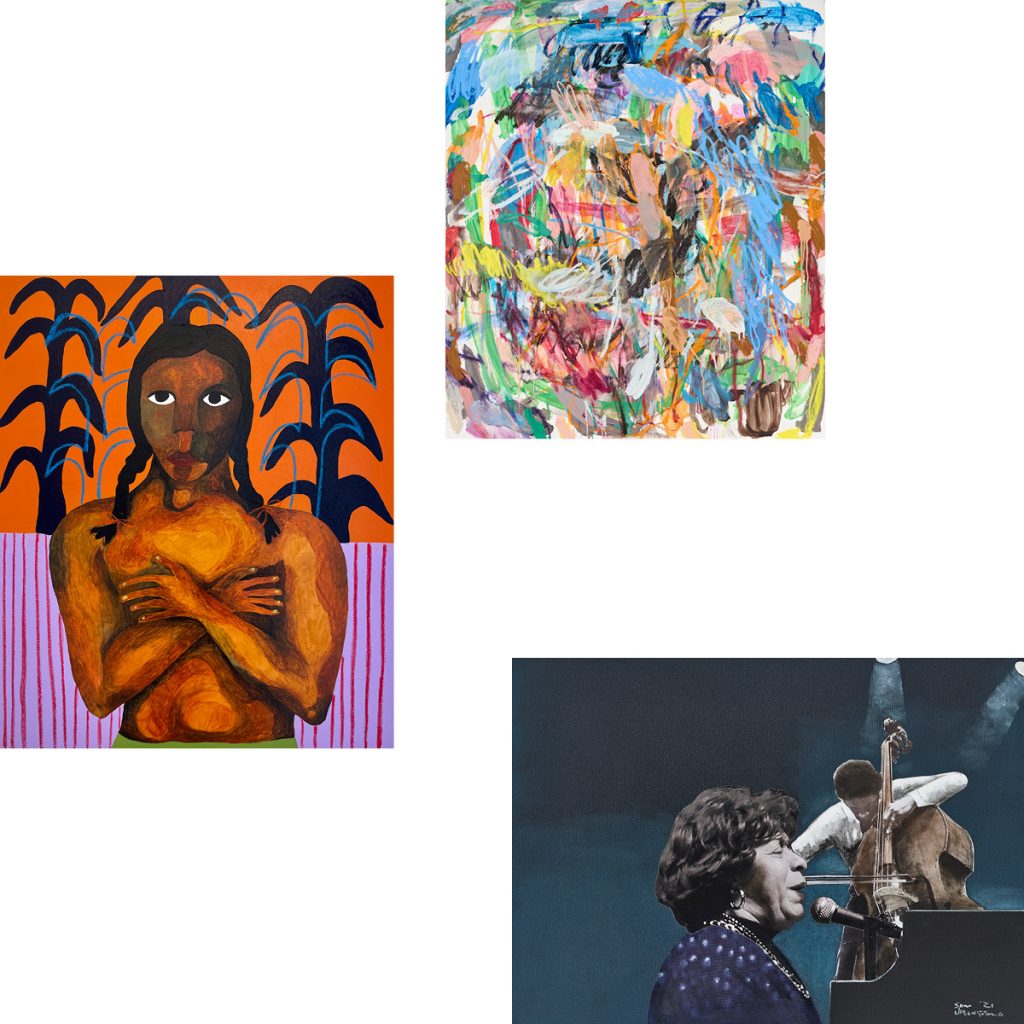
In the group exhibition at Bode, voices from southern Africa rethink movement — politically, poetically, personally. September in Berlin always feels like a state of emergency: the city is full, the streets are crowded, minds are overloaded, school has started up again, and everything is in motion. The title of the exhibition (opening tomorrow, 05.09.2025) at Bode could hardly be more fitting: Still Moving. Curated by choreographer and interdisciplinary artist Jessica Nupen, the exhibition brings together voices from southern Africa who understand movement beyond a purely physical phenomenon, and as something political, poetic, and personal. The works span mediums such as painting, sculpture, and installation, opening a dialogue between memory and ritual. Renowned artists such as William Kentridge, Sam Nhlengethwa, and Misheck Masamvu are presented alongside younger artists, including Boemo Diale, Nthabiseng Kekana, Frances Goodman, and Rosie Mudge.

The curatorial approach reveals the many ways movement can be conceived and visualized. Kentridge, internationally known for his playful animations and dynamic drawings, engages with the erasures and contradictions in history. Nhlengethwa translates jazz into a language of survival. Masamvu paints the fragile terrain of Zimbabwe with raw, rhythmic energy. Diale and Kekana explore the body as an archive, Goodman frames it as a battlefield, while Mudge transforms it into a shimmering surface full of contradictions. Together, their works create a panorama that renders movement tangible as a choreography of identities, memories, and spaces. Or, as Nupen puts it: “The exhibition challenges us to rethink our ideas about movement”. And perhaps feel them anew — movement as transformation, as a cautious or powerful gesture, as something ever present, even in silence.

Text: Hilka Dirks / Credit: Boemo Diale; Misheck Masamvu; Sam Nhlengethwa; Bode

Bode, Karl-Marx-Allee 82, 10243 Berlin–Friedrichshain; map

Still Moving until 19.10.2025. The opening takes place on 05.09.2025, featuring a live music performance by Bastian Duncker (saxophone), Sebastian Böhlen (guitar), and Sidney Werner (bass).

@bode.gallery

cee_cee_logo
A LITTLE PUNK, A LITTLE POETRY: HELGA PARIS’S PERSPECTIVE OF THE GDR AT FOTOGRAFISKA

A LITTLE PUNK, A LITTLE POETRY: HELGA PARIS’S PERSPECTIVE OF THE GDR AT FOTOGRAFISKA

People who are fully with themselves — sitting at bus stops, gazing absentmindedly into the distance, or rushing from one appointment to the next, with no time to fix their hair — these were Helga Paris’s favorite subjects. The unadorned, honest encounters that the self-taught photographer captured throughout her life in black-and-white snapshots. Her unposed series with titles like Berliner Jugendliche, Mein Alex, and Hellersdorf still tell of a divided Germany, which she began portraying almost incidentally in the 1980s. The exhibition für uns at Fotografiska, honoring the great East German photographer who passed away in 2024, proves that her images of neighbors, garbage collectors, bakers, waitresses, and retirement home residents remain timeless.

Paris always sought the everyday and connection in her subjects. Looking into the faces of East Berlin punks or the tired eyes of waitresses, you might imagine finding the same gazes today in Kreuzberg or Wedding. She never polished rough edges. She found beauty in crumbling façades. From her apartment in Prenzlauer Berg, she encountered the world around her with a sincere tenderness she extended to everyone without precondition. Her portraits are steeped in questions of origin and class, but Paris approached them neither didactically nor voyeuristically. In front of her camera, everyone stood on equal footing, whether she was photographing pub owners or women in work smocks. And that, so powerfully conveyed in the sensitively curated exhibition by former Nationalgalerie director Udo Kittelmann at Fotografiska, is Helga Paris’s enduring legacy: she saw the human first. She was interested in the person in front of her. In us.

Text: Laura Storfner / Credits: Nachlass Estate Helga Paris

Fotografiska Berlin, Oranienburger Str. 54, 10117 Berlin–Mitte; map

Helga Paris: für uns 06.09.2025–25.01.2026
Exhibition Takeover 06.09.2025 19–23h. Get tickets here.

@fotografiska.berlin

cee_cee_logo