


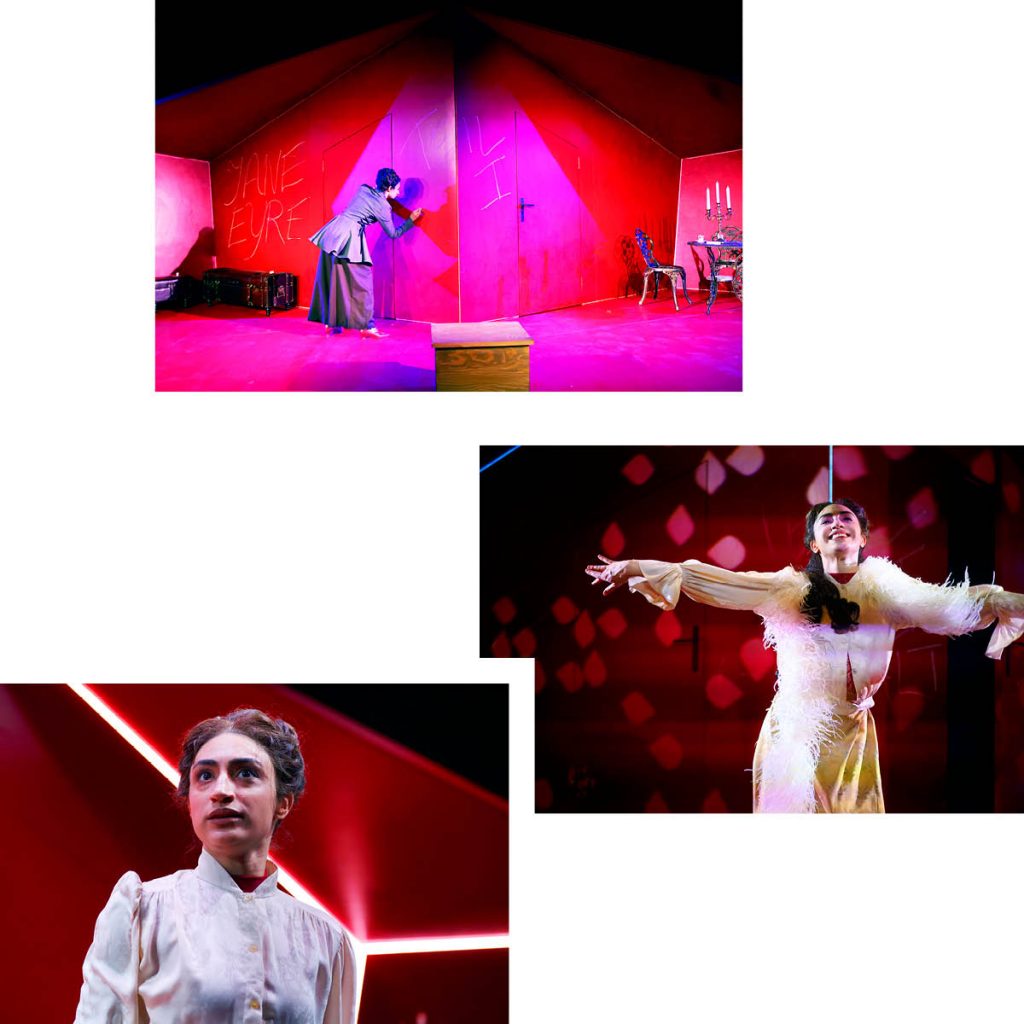
Bright red and polygonal, the stage fills Studio Я at the Maxim Gorki Theater. Actress Nairi Hadodo enters through one of the two doors that, over the course of the evening, will carry us through shifts in plot and role. In chalk, she writes on the wall: Jane Eyre. Part 1: Violence. Violence is all too familiar to Jane Eyre as an unloved orphan. Though beaten and humiliated by her family, she grows into a “headstrong” woman, with only her teacher, Miss Temple, as a confidante. Headstrong women are usually a problem — and Jane is no exception. She is angry and yearns for independence, qualities that Victorian England, as today, rarely welcomes in women. So she settles for the alternative: variety and stimulation. She becomes a teacher. Part 2: Love. As a governess, she works in a grand house for a wealthy man, Mr. Rochester. The house is eerie; Jane hears ghostly laughter, and inexplicably, at one point, the curtain in Rochester’s bedroom catches fire. Rochester (who could be a father figure) seeks entertainment in and with Jane from the start, provoking her, exploiting his power, and delighted by her defiance. Jane is different from the others. The two fall in love.
To manipulate Jane, Rochester courts the beautiful Miss Ingram, only to later propose to Jane. Jane is furious and worried about Miss Ingram’s feelings in Rochester’s toxic charade. Unbothered, Rochester continues, and eventually Jane says “yes” — only to learn at the altar that he is already married to Bertha Antoinetta Mason, a Creole dancer whom Rochester has labeled insane and hidden in his attic. Jane leaves him, and Bertha sets the house on fire. No curtain falls, and Nairi Hadodo, along with Daniela Holtz, end the play before the original plot concludes. A feminist cut: in Charlotte Brontë’s novel, Jane returns to the gravely injured Rochester. At the time of its publication, Jane Eyre was a progressive feminist hero’s journey. Yet readers often feel disappointed that Jane marries a flawed, manipulative man. The evening at the Gorki offers a far better outcome. In Hadodo’s one-woman show, she plays the self-important, macho Rochester so unbearable, delivers Jane’s monologues critiquing the glorified mediocrity of blond, white men with blue eyes, and embodies Bertha railing against her rage: “My name is Bertha Antoinetta Mason (…) and a weak white man became my undoing, because his power resided in structure, while my power resides in my body.” Hadodo weaves together the novel, pop culture, music, and plenty of fury. And while everything burns around her, one thing remains: a masterful study of female rage.
Text: Inga Krumme / Photos: Ute Langkafel (Maifoto)
Maxim Gorki Theater, Am Festungsgraben 2, 10117 Berlin–Mitte; map
Jane Eyre 09. & 10.04.2026 20h30. Remaining tickets will be available at the box office.
@maxim_gorki_theater
