


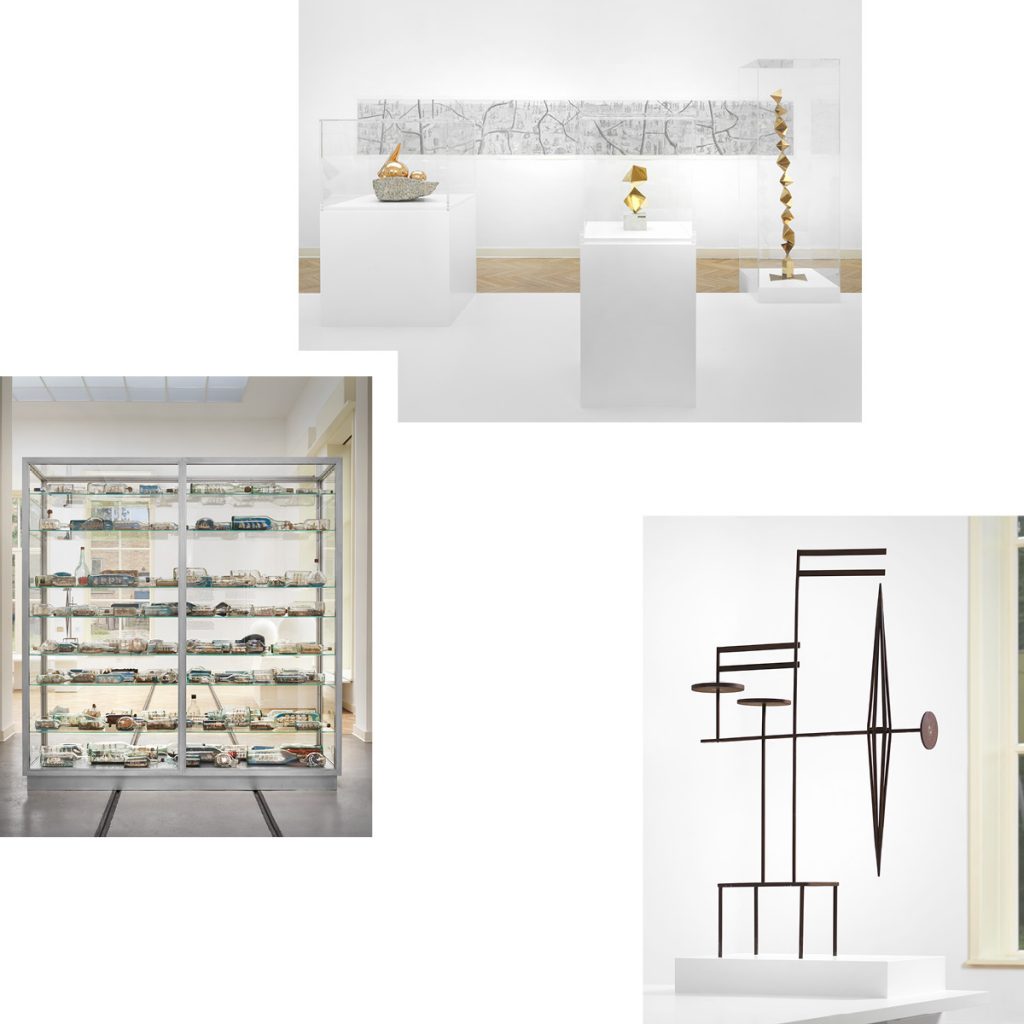
Geometric grid paintings in primary colors — red, yellow and blue — are inseparably linked to Dutch artist Piet Mondrian. But who would have thought that British artist Marlow Moss not only met Mondrian, but also influenced his abstract visual language? Seven decades after her death, Moss is being rediscovered and, for the first time in Germany, honored with a major exhibition at the Georg Kolbe Museum. Located in Berlin’s Westend, the exhibition not only tells Moss’s story but bridges it to the present day through artists such as Leonor Antunes, Tacita Dean, Florette Dijkstra and Ro Robertson. After all, Marjorie Jewel Moss (as was her full name) lived a life that would have fit right into 2026 Berlin. Born in London in 1889, she studied art, moved to Cornwall, and reinvented herself with cropped hair, tailored suits, and a new name: “Marlow”. And although the artist continued to use the pronoun “she” and never openly defined her sexuality, she felt most at ease living in a way that we would likely describe as queer today.
In the late 1920s, Marlow Moss moved to Paris, where she became part of the avant-garde scene and eventually met Piet Mondrian. The two exchanged ideas and influenced each other’s work. While Mondrian emigrated to New York, Jewish Moss initially retreated to the Dutch province of Zeeland at the outbreak of World War II, before fleeing to Cornwall. Until her death, she lived and worked in seclusion in the small fishing village of Lamorna. During these years of exile, her work remained a constant, even if it was not appreciated in Great Britain to the same extent as it had been in France and the Netherlands. In Berlin’s Westend, her sculptures — only a few of which have survived — are being shown for the first time. She paired smoothly polished golden spheres with granite from the rugged southwest coast of England. The way nature and abstraction defined her practice is particularly striking in one of her sculptures in the garden of the Georg Kolbe Museum. Curators Lucy Howarth and Elisa Tamaschke have succeeded in creating an exhibition that presents a multifaceted artist in all her dimensions and contradictions: a visionary who is finally receiving the recognition she deserved in her lifetime.
Text: Laura Storfner / Photos: Jens Ziehe
Georg Kolbe Museum, Sensburger Allee 25, 14055 Berlin–Westend; map
Creating Space: The Constructivist Marlow Moss – with Leonor Antunes, Tacita Dean, Florette Dijkstra and Ro Robertson until 26.07.2026
@georgkolbemuseum
@kathleen.reinhardt
@leonorleonorantunes
@tacita_dean
@ro_robertson_
@lucyhahowarth
@elisatamaschke
