


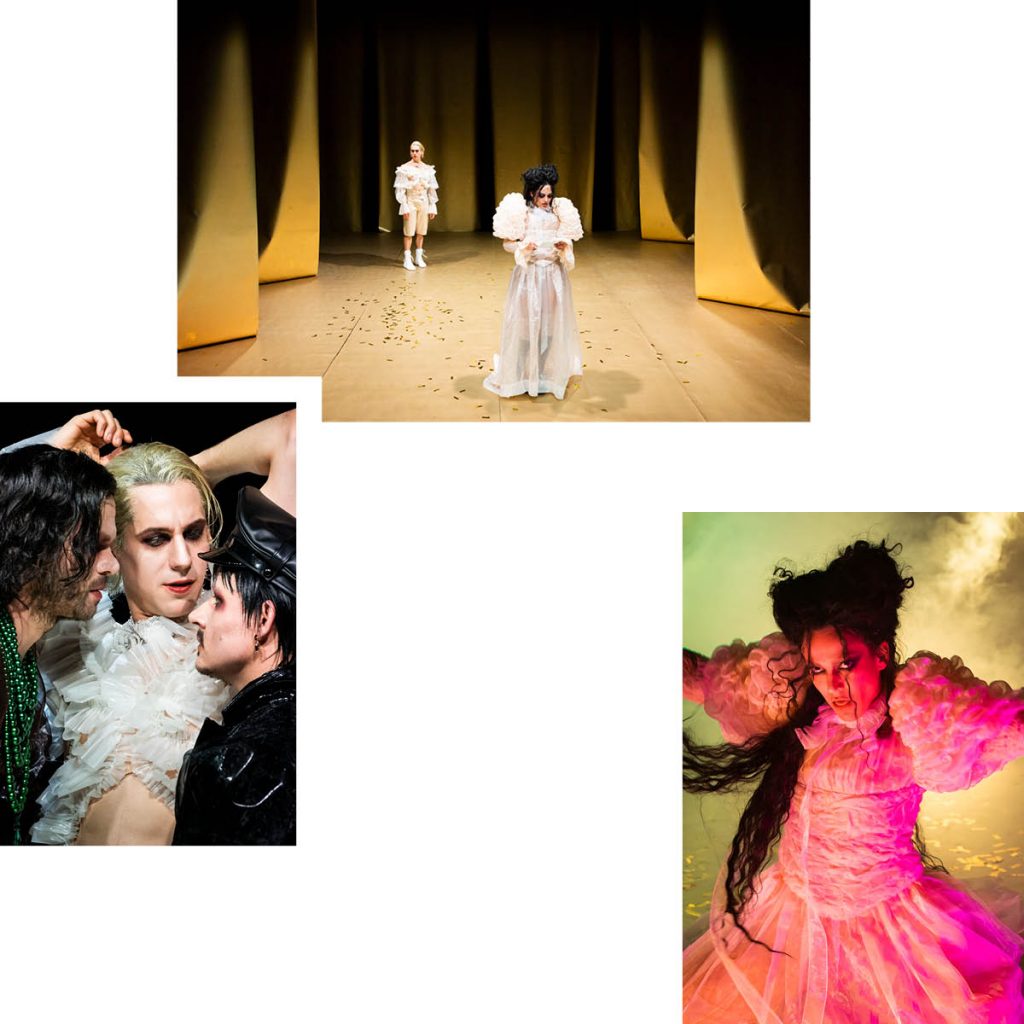
Do you see what I see? On the stage of the Neues Haus at the Berliner Ensemble, an actor leans gracefully into the pose of Michelangelo’s David with every step. Ballet-footed and infinitely strong. Max Gindorff plays the excessive protagonist from Oscar Wilde’s only novel, The Picture of Dorian Gray. Dorian Gray is beautiful — strikingly so. His appearance ignites the desire of London’s upper class, not least that of painter Basil Hallward (Paul Zichner), who has poured all his love onto the canvas for which Dorian served as a model. Fearing that society might read his feelings in the painting, Basil insists it must remain unseen. Lord Henry (Gabriel Schneider), on the other hand, fuels what Dorian has only begun to suspect: that youth and beauty are all that truly matter. And so Dorian trades places with the portrait, remaining eternally young and beautiful while decaying within. He gives himself over to excess, despises others, and even commits murder. Yet he faces no consequences — the portrait bears all his guilt and transgressions. That this includes queer desire is made strikingly visible by director Heiki Riipinen. After all, it formed part of the charges in the indecency trial against Oscar Wilde in 1895. Beyond the cast, it’s the latex puff sleeves that make this production so electrifying. Add to that patent leather boots, long trains, cropped tops — queer clichés, perhaps. And yet, they seem to reflect an ongoing struggle for even the most basic rights, one that inevitably pushes toward excess.
Costume designer Louise-Fee Nitschke grants the performers proud yet delicate silhouettes — rendering Dorian almost angelic, while Lord Henry hovers somewhere near Nosferatu. From these looks, the otherwise minimal stage design seems to grow, as if it had been waiting for the performers all along. It quite literally offers them a stage, I find myself thinking. A chaise longue here, buckets of artificial snow there, guide the way. Anyone sensing the decadence of Victorian England in these images will recognize the glossy aesthetics of today — and perhaps feel the urge to escape them. Which is why a Berlin techno party is never far off. In this production, however, it doesn’t try to be anything else, nor does it insist on reminding us that we are in Berlin. It’s simply good. Amal Keller is the remarkable actress Dorian falls head over heels in love with. She also embodies her character’s brother, who threatens Dorian with death should he fail to make his sister happy — and, ultimately, Oscar Wilde himself. There’s no stopping her: dancing to Charli XCX, she quite masterfully moves toward her own demise. Even during the intermission, the dancing continues — Dorian is constantly charged with energy. And again and again, the perspective shifts. When Max Gindorff, alongside painter Basil, steals a glance at the portrait, which, spellbound, sits right in front of them, the audience. Have we changed? This evening is far too beautiful to last only two and a half hours, and Oscar Wilde’s work is far too relevant to be forgotten. In this parable, queer life is given the space it deserves. And we are left to witness it.
Text: Emma Zylla / Photos: Jörg Brüggemann
Berliner Ensemble, Bertolt-Brecht-Platz 1, 10117 Berlin–Mitte; map
The Picture of Dorian Gray. Ticket sales start on 04.04.2026.
@blnensemble
