


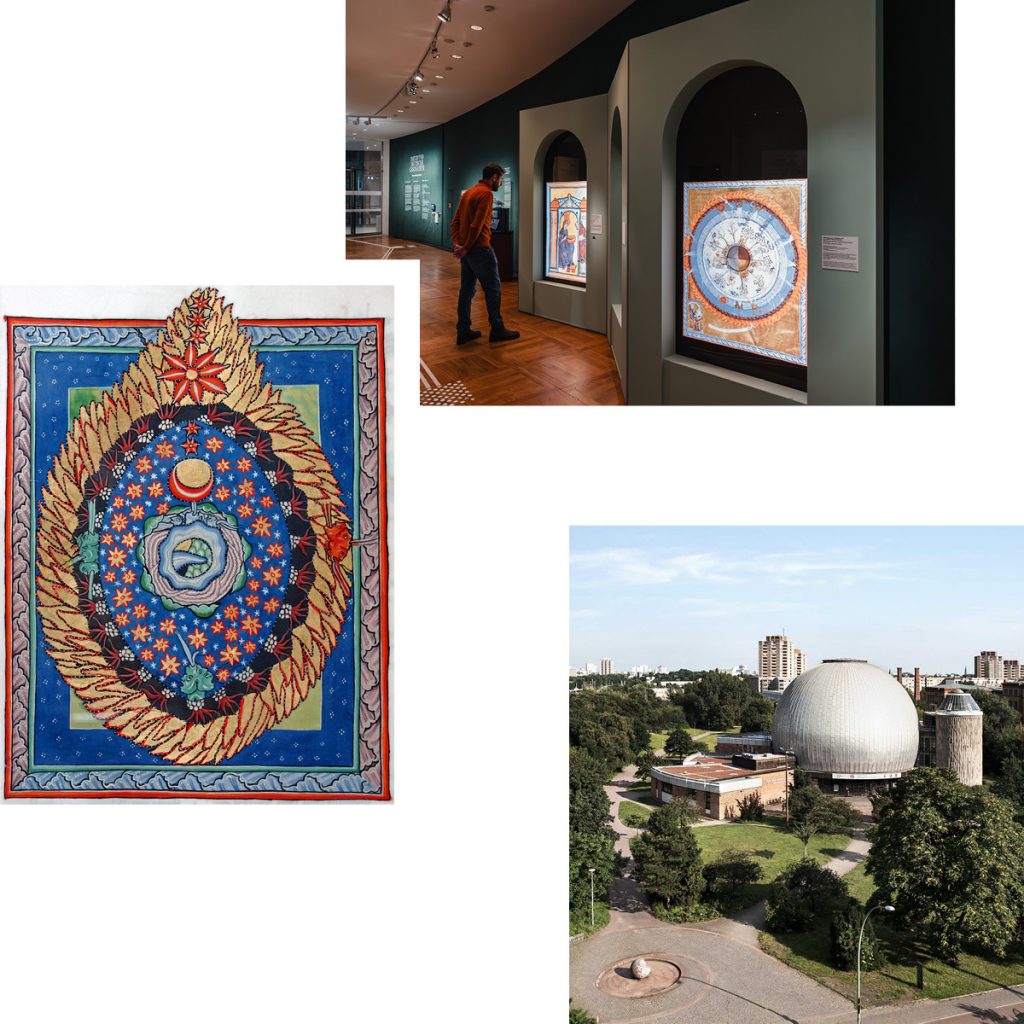
At the Zeiss Planetarium, visitors immerse themselves in the medieval cosmos of the mystic Hildegard of Bingen. Darkness unfolds across the planetarium dome, mystical chants echo, and images from medieval illustrations come to life. These are fragments — compositions, sounds, and passages — from Hildegard of Bingen’s visionary masterwork Scivias. Reclining in the planetarium seats, one can trace the thinking of this progressive philosopher, theologian, artist, naturalist, composer, and physician, who in the 12th century served as abbess of the Rupertsberg Monastery near Bingen on the Rhine. The English-language audiovisual program follows Hildegard’s ideas through the stages of creation as laid out in Genesis, revolving around the image of the “cosmic egg”: a geocentric model in which the sun, moon, and stars orbit the Earth, while light and darkness, order and conflict, interact. This universe is both a reflection of medieval knowledge and a space imbued with spiritual forces. There is something poetically comforting in watching the dark stars fall into waves, or observing the sometimes quaintly animated schools of fish overhead, as a voiceover guides viewers through the imagery.
The surviving documents of Hildegard of Bingen testify to a keen, wonder-filled gaze of the world and a persistent inquiry into the relationship between humans, nature, and the cosmos. The scholarly knowledge of the 12th century forms the basis of her depictions, which she translates into images, interprets, condenses, and transforms into a comprehensive theological symbolism. The animations are based on a color reproduction of the now-lost original manuscript, created in the early 1930s by the Benedictine nuns of St. Hildegard Abbey in Eibingen. As one contemplates the ornaments of the cosmos, one feels fully encompassed — part of a larger whole and suspended in the gentle relativity of time.
Text: Hilka Dirks / Credit: Abtei St. Hildegard, Rüdesheim-Eibingen; Deutsches Historisches Museum / Photos: Natalie Toczek, Sandra Kühnapfel
Zeiss-Großplanetarium, Prenzlauer Allee 80, 10405 Berlin–Prenzlauer Berg; map
Creation and Cosmos according to Hildegard of Bingen 19.02., 05. & 19.03.2026 from 15h30 (in English).
@dhmberlin
@planetarium.berlin
