


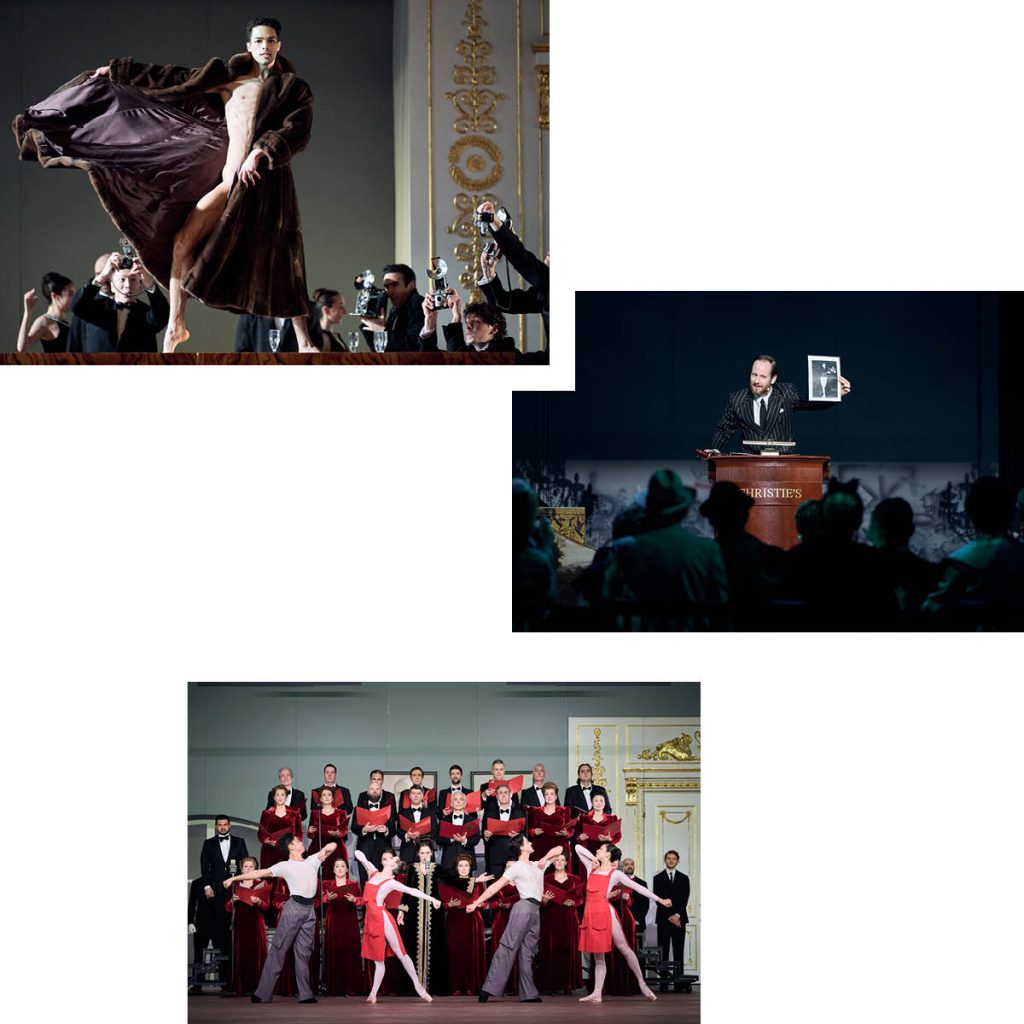
We are spectators at an auction. Rolls of wallpaper from a private bedroom, a harpsichord, an archipelago with a villa and its accompanying dance studio — what’s for sale is the life of Rudolf Chametowitsch Nureyev, one of the most famous ballet dancers of all time. In 1961, he went into exile in France, launching the legendary career of a man with a larger-than-life personality. This production was once meant to be suppressed, yet it became a huge success. Today, it is banned in Russia for violating the country’s anti-LGBTQ laws, as Nureyev was gay. Director Kirill Serebrennikov and choreographer Yuri Possokhov first staged the piece at the Bolshoi in Moscow in 2017. Now, it’s performed by the Staatsballett and can be seen in Berlin. At the Deutsche Oper, the stage transforms: the next setting is a ballet studio, and here we meet Rudolf Nureyev. From this moment on, he is almost constantly present — whether in a solo, at the edge, or lingering in the background in a demi-plié, perfectly framed in the scenic view. The narrative is intricately woven through actor Odin Lund Biron, who alternates between auctioneer, Soviet official, and reader of love letters. The evening’s pas de deux begins tense in the rehearsal room, softens gracefully at the barre with Nureyev’s partner Erik Bruhn, or plays out dramatically beneath a chandelier with Dame Margot Fonteyn, with whom he shared a uniquely close professional partnership.
After the intermission, the perspective shifts. We sit in the auction, the audience paying their bids. Then comes the great liberation. David Soares as Nureyev dances through glittering nightlife with his queer entourage, through ballrooms, into Richard Avedon’s photo studio. Nureyev dances on tables, naked in mink, chased by paparazzi — everything is monumental. Nureyev intervenes, Nureyev makes announcements, Nureyev loses control. He rises as the Sun King over the bent backs of men. Interspersed throughout and particularly delightful is the auction audience in their gray suits. In the final scene, La Bayadère, dancers descend a ramp in zigzags, a nod to Nureyev’s choreographic signature. Bent by AIDS infection, he steps into the orchestra pit and takes up the baton. Nureyev conducts his own closing number. Ilya Demutsky’s music is a lush collage, rich with Tchaikovsky, and the costumes and set change in midair, evoking fragments of Swan Lake. At times, a choir appears on stage. But anyone expecting a Tchaikovsky fantasy or the usually straightforward stage language of Christian Spuck is in for a surprise. This is a strikingly didactic ballet (and play) that tells a life story. And it’s as lavish as the Staatsballett Berlin has been in years. With Nureyev, a great character is portrayed in grand style. There are one or two moments that verge on kitsch, but I cannot fault it. After all, this life can only be told in an over-the-top spectacle, a truth made clear when Nureyev himself sets the final tempo.
Text: Inga Krumme / Photos: Carlos Quezada
Deutsche Oper, Bismarckstr.35, 10627 Berlin–Charlottenburg; map
Nureyev. Find all the dates here.
@staatsballetberlin
@deutscheoperberlin
