
Cee Cee Creative Newsletter Book Neighborhood Map Lessons
Stadtplan
Information
home temp
loop temp
DISCOVER UNESCO WORLD HERITAGE SITES & BERLIN MODERNIST HOUSING ESTATES ON GUIDED TOURS

DISCOVER UNESCO WORLD HERITAGE SITES & BERLIN MODERNIST HOUSING ESTATES ON GUIDED TOURS

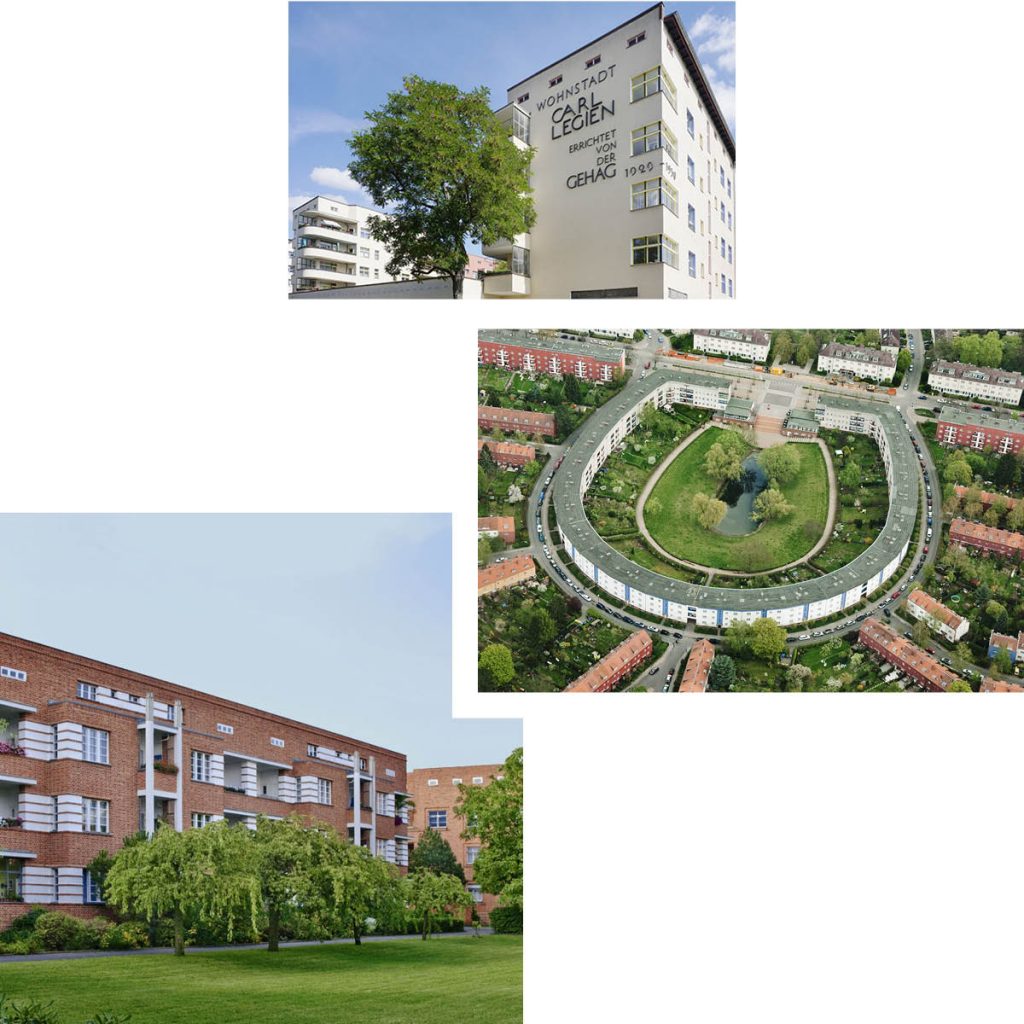
Did you know that there are eight sites in Berlin that have UNESCO World Heritage status? There’s Museum Island and the Prussian Palaces and Parks, but also six modernist housing estates which have held the distinction for over a decade. The housing estates were built between 1913 and 1934 to alleviate severe housing shortages. Star architects Bruno Taut, Walter Gropius and Hans Scharoun (architect of the Berlin Philharmonic) rapidly realized new urban models offering affordable and modern housing with lots of light, air and sun with beautifully blooming gardens and green parks. The idea: offer an alternative to Berlin’s old buildings with dark courtyards and toilets in the stairwells. The housing estates – Hufeisensiedlung in Britz, Gartenstadt FalkenbergWohnstadt Carl Legien in Prenzlauer Berg and the Waldsiedlung Zehlendor – are still sought-after residential properties today, and not only for architects and designers. This includes the author Ben Buschfeld, who himself lives in the Hufeisensiedlung (architect: Bruno Taut) in Britz and runs the ‘Taut’s Home‘ museum there.

Taut’s house can be rented and is preserved in its original condition. This weekend, Buschfeld, who works as an architectural mediator and expert on 1920s architecture, is offering guided tours of the four of the six housing estates. These are considered Berlin’s most important contribution to international architectural history, both politically and in terms of design. They offered groundbreaking housing solutions for Berlin and provided answers to the highly topical questions of how we want to live and what politics can do for people. A worthwhile architectural walk with a lasting impact.

Text: Milena Kalojanov / Photos: Ben Buschfeld

Guided tours with Ben Buschfeld:
Hufeisensiedlung Britz (02.06.) from 17h
Gartenstadt Falkenberg (02.06.) from 10h30
Wohnstadt Karl Legien (03.06.) from 15h
Waldsiedlung Zehlendorf (04.06.) from 10h30

You can register for a tour by emailing tours@buschfeld.com. Minimum number of ten participants. You can find more information here and here.

cee_cee_logo
HOMEMADE BAGELS AND DESSERTS AT THE CHARMING ODD CAFÉ

HOMEMADE BAGELS AND DESSERTS AT THE CHARMING ODD CAFÉ

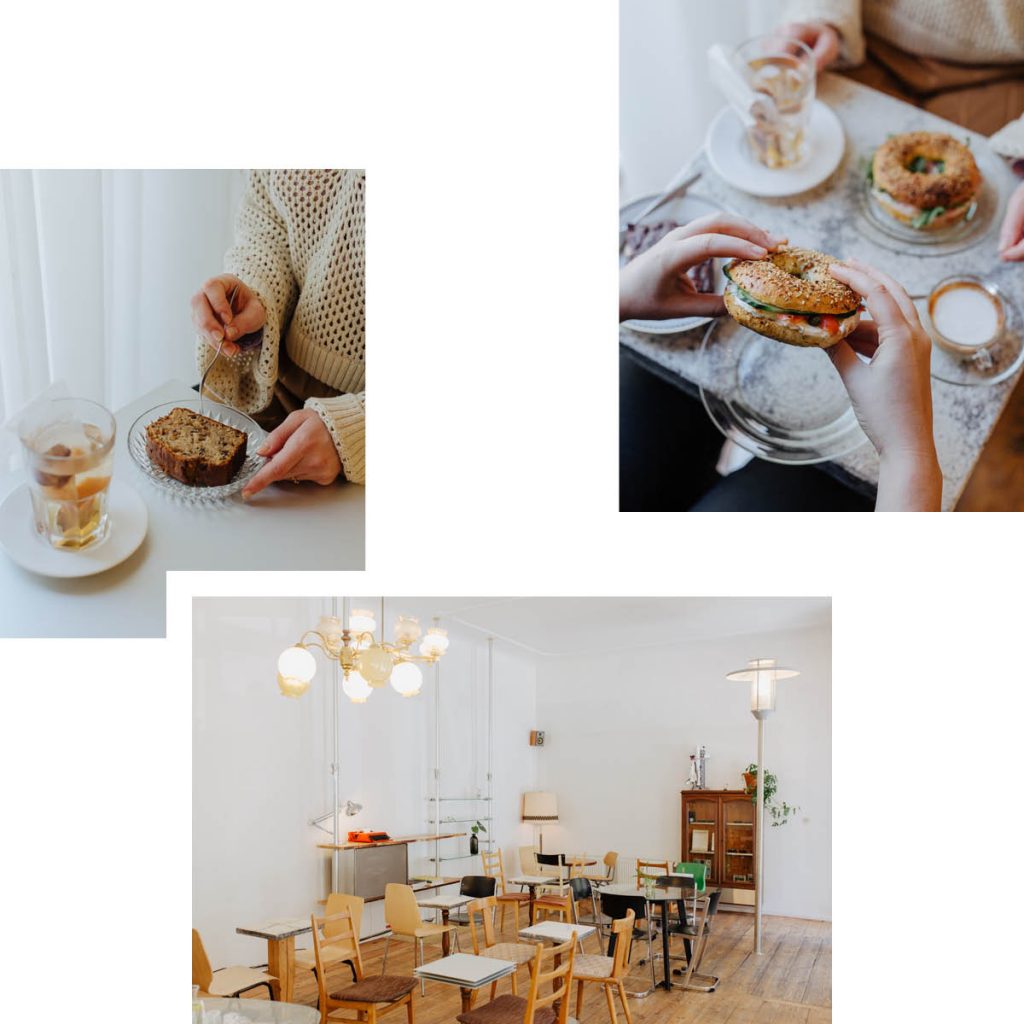
There are two bears at Odd Café. There’s one that lays overturned, with its paws holding the glass of a table. Another, smaller, is made of china and roams amongst the bagels in the counter cabinet. The place is not named after these small oddities, but rather the odd, coincidental trio of friends that came together to start the cafe in April 2023. Despite all odds, the trio – Sanghyun No and Jonghwan Kim from South Korea (and the people behind Swordmaster Noodle), and their friend Ivana Stanic from Serbia – met and decided to open this neighborhood cafe together.

While the space has charming handmade furniture – repurposed table legs stand alone holding stone tabletops, mismatched chairs, even a rocket and typewriter – it’s intention and design keep the space sleek and bright. Brighter still is the service: the team are clearly enjoying running their new space and it seeps into the friendly service. For a savory treat, bagels are handmade onsite by Ivana. Our favorites are the salmon and cream cheese, and the goat cheese and honey. They’re perfectly seasoned and make an easy breakfast with a friend, or for an un-messy remote working breakfast if you decide to set up and work here for the day. If you’d like something sweet, they have cakes also made in-house, including a whisky honey cake, basque cheesecake, apple cinnamon blondie or a classic chunky choc-brownie. Their Lotus latte is made with Biscotti (yum) and they have a Bonbon espresso, which is Sanghyun’s take on a Vietnamese condensed milk coffee. All the coffee uses a single origin Ethiopian Sidamo bean – Sanghyun’s preference and a favorite among coffee enthusiasts. Their teas are also special – hand packaged themselves, they have a special Sujeong Cha tea which is a reinterpretation of the traditional Korean Sujeong cinnamon tea, Jeju Baram green tea and Jeju Dol which is made from organic brown roasted rice and green tea. Between their sweets, bagels, sunny terrace and neighborhood-cafe service, there’s many reasons it’s not so odd to visit Odd.

Text & Photos: Savannah van der Niet

Odd Café, Zelterstr.6, 10439 Berlin–Prenzlauer Berg; map
Wed–Sun 8h30–17h30

@odd_cafe_ber

cee_cee_logo
POWDER ROOM: DAILY GLOW WITH FACIALS AND KOREAN SKIN CARE

POWDER ROOM: DAILY GLOW WITH FACIALS AND KOREAN SKIN CARE

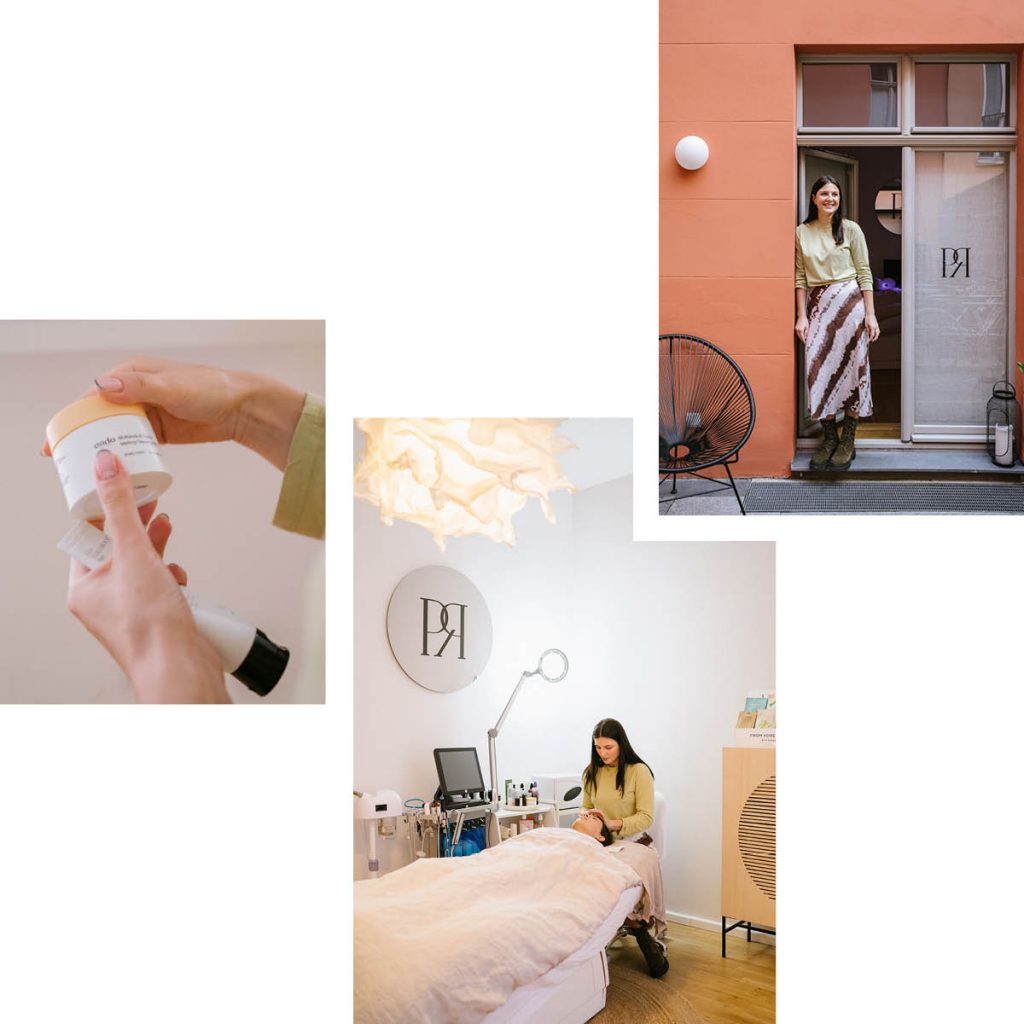
Is your skin dry, irritated, red? Do you want to give it some extra attention and care? The Powder Room is the right place for you. Since July 2021, you’ll find Daphne’s salon hidden in the backyard of Mitte’s Scheunenviertel. The owner, skin care enthusiast and professed lover of Korean Skin Care moved from Munich to Berlin in 2018 – and thus moved from the cosmetics and beauty industry to the practical craft in her own Powder Room: the ideal place for all questions regarding skin care and health, taking into account the individual’s (often hormonal) distinct needs. Daphne takes time for questions, addresses any acute issues and talks through your regular routine with you before you enjoy an individually tailored facial, extensive facial massages included. Hydrafacials with microdermabrasion rid the skin of impurities, boost cell renewal and provide an extra dose of moisture – without redness and downtime. It’s a lunchtime treatment, so to speak, because you can get back to work right afterward. In addition, the Powder Room, in keeping with the bright and minimalist interior, uses almost exclusively Korean products that have convinced many people, not just Daphne, with their natural ingredients and good tolerance. In other words, with high-tech facials and K-Beauty, you can say bye-bye to the 10-step beauty routine and hello to the perhaps “future” neighborhood esthetician.

Text: Alison Musch / Photos: Sophie Doering

Powder Room, Almstadt Str.24, 10119 Berlin–Mitte; map
Tue–Fri 10–20h & Sat 10–17h

@powderroom_berlin

cee_cee_logo
CULTURAL ENCOUNTERS: CHILI & PAPRIKA STORE —  RECOMMENDED BY ANDREA ELSPER

CULTURAL ENCOUNTERS: CHILI & PAPRIKA STORE — RECOMMENDED BY ANDREA ELSPER

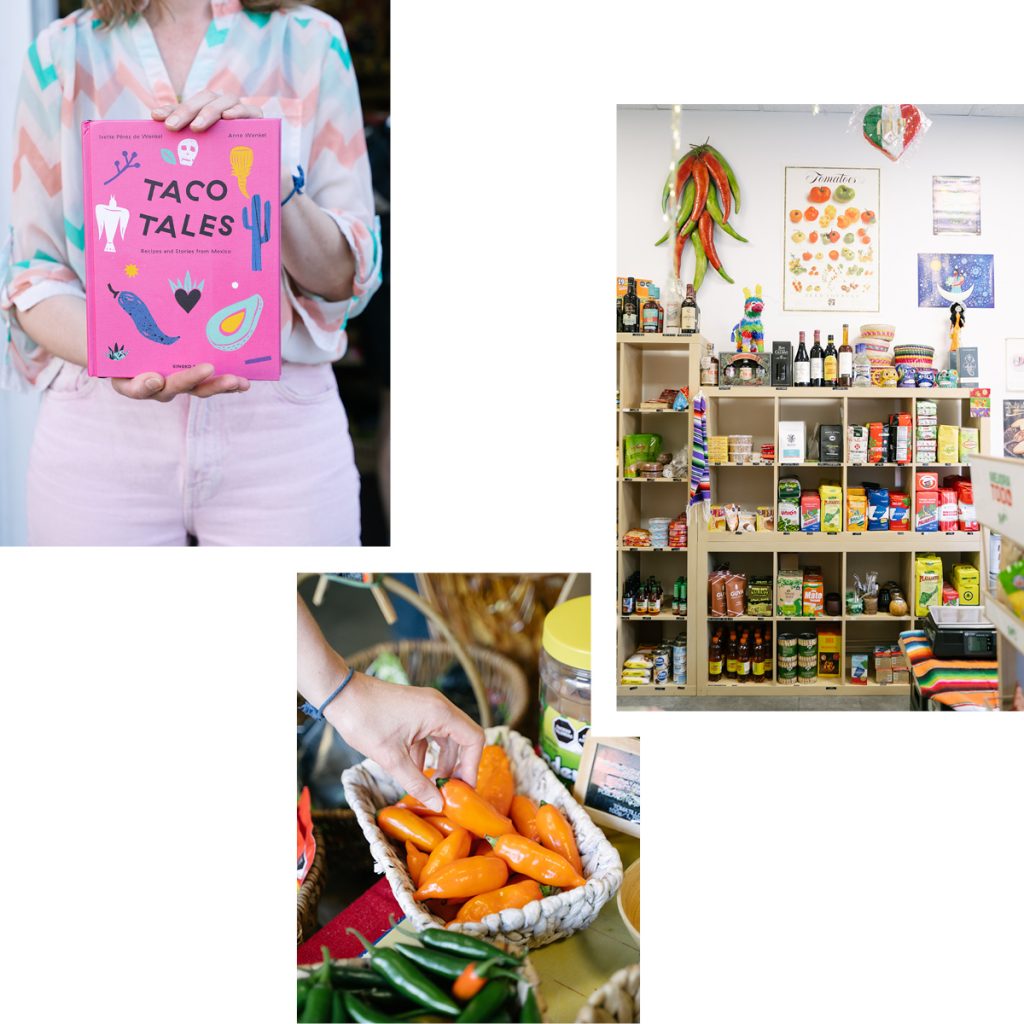
The small store Chili & Paprika at the corner of Danziger and Greifswalder Straße is almost easy to miss from the outside. But once you find the door, a universe of its own opens up: it’s colorful and exuberant here. Piñatas hang from the ceiling, colorful skulls are everywhere, catrinas stand between fresh green tomatoes and colorful packaging. Here, you can feel the merging of Latin American food and culture. This cultural exchange is particularly important to founder Mathias Jung, who opened the store 10 years ago and has since been assisted by Karina. It all started with cooking: Mathias was introduced to chilis in various kitchens in Berlin, and his passion was sparked. In exchange with like-minded people, it quickly became clear that there was a lack of supply in Berlin. And so the store was born – Chili und Paprika has kept its name to this day, but the assortment has expanded and now includes products from Colombia, Peru, Venezuela, Nicaragua and Costa Rica in addition to goods from Mexico.

Time and again, events take place in front of the store: from coffee tastings to music performances. On traditional holidays such as Dia de Muertos (31.10.-02.11.) in particular, you can experience a touch of Mexico, but cultural exchange also comes through the palate. If you don’t know yet what chipotle tastes like or what’s behind the word “mole,” you should take the plunge. I did and since then I can’t imagine my life without the smoky flavor and chocolate/chili. It’s also healing to give tequila a second chance. Shelved in the collective memory of a 90s youth as a bottled drink with a red hat on it, enjoyable only with lemon and salt thrown in at the same time, tequila deserves credit as so much more. A real tequila is made from 100 percent blue agave, the original variant of which is mezcal, a mixture of agave that is then heated in a pit to dissolve the pulp. The flavor that emerges is faintly smoky, intense, and it immediately becomes clear why this drink was once seen as a divine compound and reserved for rituals. Another speciality of the store are the fresh tortillas. These come from the first organic tortilleria in Europe Tlaxcalli Nixtamal, which is located not far from the gates of Berlin and grows its corn without any genetic engineering. Of course, there are also classic tortillas chips with homemade dips. But if you want to get to know the diversity of Latin America, we recommend the cookbook “Taco Tales” by Ivette Perez de Wenkel, which also provides plenty of reasons to visit the store again and again.

Text: Andrea Elsper  / Photos: Robyn Steffen

Andrea Elsper lives in Berlin and works as an art director and set designer for CeeCee, among other clients. She finds inspiration on her extensive travels and enjoys bringing these culinary influences back to Germany.

Chili und Paprika, Danziger Str.118, 10405 Berlin–Friedrichshain; map
Thu-Fri 13–18h30, Sat 12–17h30

@chili_und_paprika_berlin

cee_cee_logo
BY NATURE: JULIUS VON BISMARCK AT THE BERLINISCHE GALERIE

BY NATURE: JULIUS VON BISMARCK AT THE BERLINISCHE GALERIE

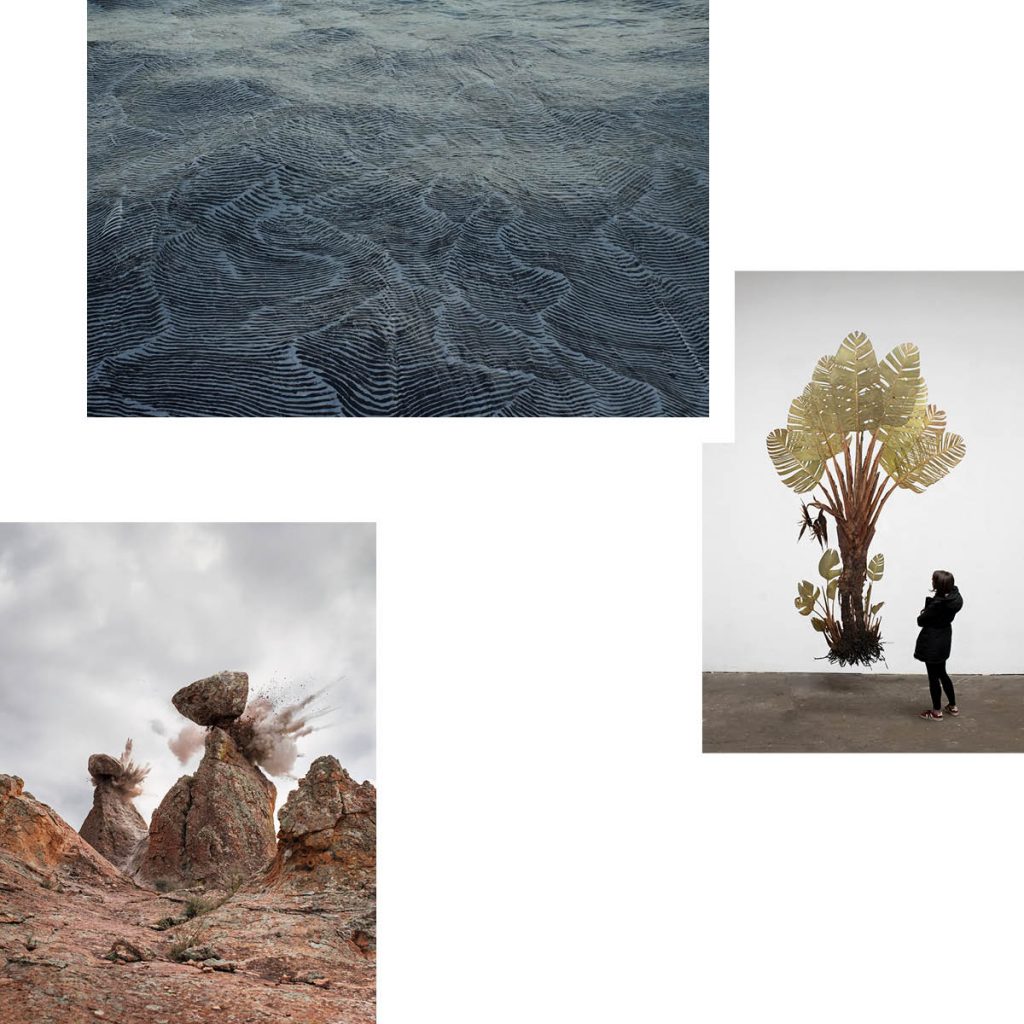
The reciprocal relationship between man and nature has always preoccupied the artist Julius von Bismarck. In his new exhibition, with which the Berlinische Galerie reopens today after a three-month closure for renovation work, he combines his studies of nature with biographical questions for the first time: an oversized cloth with drawings of a water surface leads visitors into the show. It shows the so-called Bismarck Sea in the Pacific Ocean and symbolizes the wide circles Bismarck’s family history draws in the German colonial past. Climate change and its consequences are also omnipresent in the work. His new series “I like the flowers” deals with the colonial practice of the herbarium, in which dried, pressed plants define the space as sculpture. The work is reminiscent of houseplants with which we decorate our homes. It is also to be understood as a commentary on the exoticizing representation with which some places in this world are stylized into places of longing.

The centerpiece of the exhibition is a life-size giraffe and a scaled-down version of Bremen’s equestrian statue of Otto von Bismarck. Like the children’s toy of the spinning figurine, both figures are composed of individual limbs that allow the figures to collapse in on themselves and rise up again. All of the works are thus connected by the question of how man deals with nature, and which plants, animals and parts of the earth he considers worth protecting and which he does not. With his exhibition, Bismarck provides us with refreshing food for thought, allowing us to take a critical look at the Anthropocene without lecturing – always aware that in the end it is nature that has the upper hand.

Text: Laura Storfner / Credit: Julius von Bismarck; alexander levy, Berlin, and Sies + Höke, Düsseldorf, VG Bild-Kunst, Bonn 2023

Berlinische Galerie, Alte Jakobstr.124-128, 10969 Berlin–Kreuzberg; map

Julius von Bismarck: When Platitudes Become Form” 26.05.–14.08.2023 Wed–Mon 10–18h. Admission 10 Euro/6 Euro reduced.

@berlinischegalerie

cee_cee_logo