
Cee Cee Creative Newsletter Book Neighborhood Map Lessons
Stadtplan
Information
archive temp
loop temp
POLYPHONIC & CLOSE: STRING QUARTET REIMAGINED AT SOMEHOW WE CAN

POLYPHONIC & CLOSE: STRING QUARTET REIMAGINED AT SOMEHOW WE CAN

How does closeness sound? What happens when music is not just played, but shared between musicians and audience, between past and present? With Somehow We Can, the Solistenensemble Kaleidoskop opens up a space for connection at the Radialsystem. Not a classical concert, it’s curated by composer Ethan Braun, uniting eleven compositions and twelve performers who further the string quartet genre as a living network of relationships, as a collective expression of art and society. The program moves between tonal delicacy, formal deconstruction, and political relevance. It allows marginalized voices to be heard in the canon of new music (such as BiPoC and LGBTQ+ composers), where the quartet is a place where differences are celebrated, not squashed. Alvin Singleton explores coexistence without the pressure for harmony, Yuri Umemoto brings pop-cultural references, and Sarah Davachi transforms microtonality into a sensual experience. Together, they show how new music can be polyphonic, political, and accessible. Listen, it resonates — a space of possibility.

Text: Inga Krumme / Photos: Julian Blum, Romanos Lioutas, Sonja Müller

Radialsystem, Holzmarktstr.33, 10243 Berlin–Friedrichshain; map
Somehow We Can – 11 String Quartets. Tickets (pay what you can) can be purchased here.

@radialsystem_berlin
@solistenensemble.kaleidoskop

cee_cee_logo
GALLERY MEETS KIOSK MEETS CULTURE — THE PALAST KIOSK ON STEINPLATZ

GALLERY MEETS KIOSK MEETS CULTURE — THE PALAST KIOSK ON STEINPLATZ

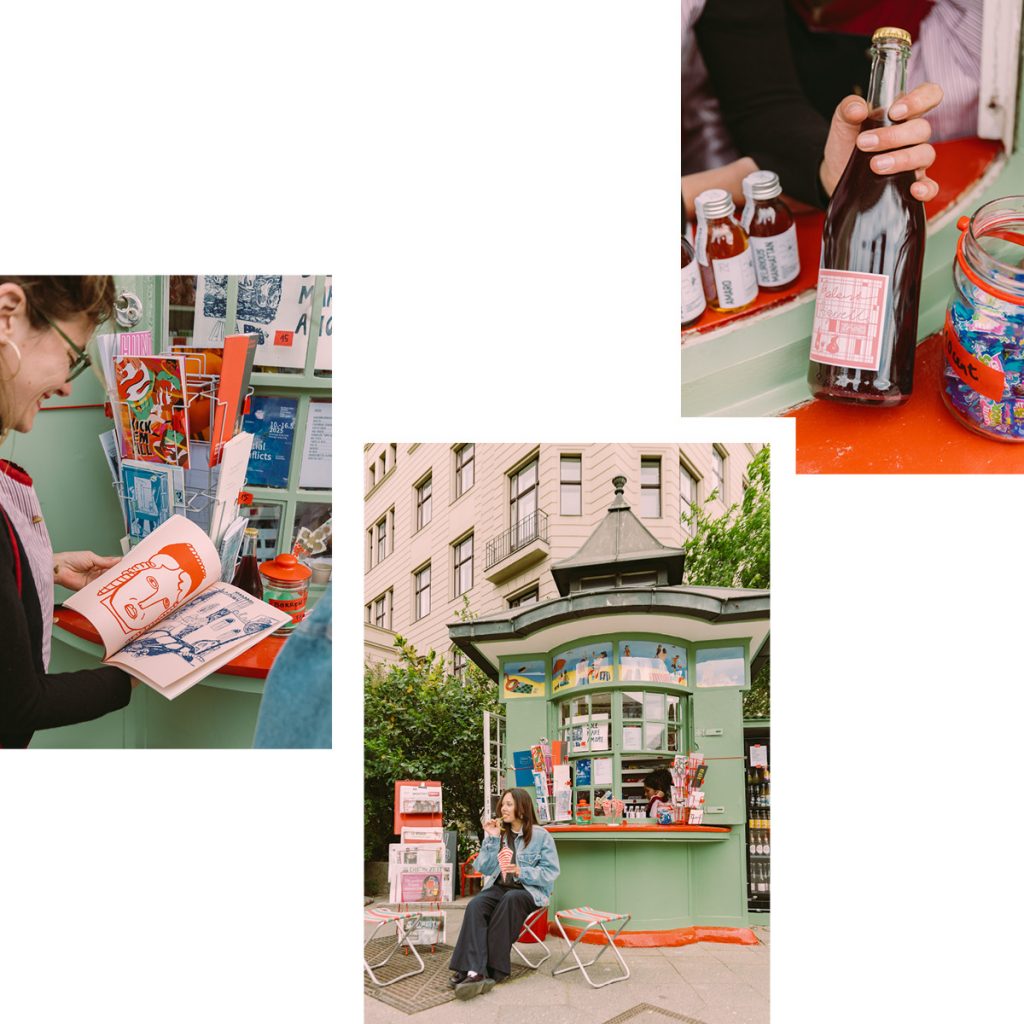
For years, Elena Höller and Nicola Schüschke had their eyes on a small architectural gem: the kiosk on Steinplatz. Empty since the pandemic and recently released for temporary use, the two seized the opportunity. With a concept rooted in art education, a revival of kiosk culture, and a little luck, not to mention the help of friends, fellow students, and the Charlottenburg-Wilmersdorf district office, they were able to open the Palast Kiosk in April 2025. The kiosk is one of the few remaining designed by Alfred Grenander (1863–1931), an architect who once shaped the streetscape of Charlottenburg. Another of his designs still stands on Savignyplatz, now home to a sausage stand. Grenander’s designs are unique, proportioned, functional, and distinctly colored – in the case of Steinplatz, a mint green that has become iconic.

While many of these kiosks have been demolished or altered, this one has remained mostly intact. After a year of approvals and renovations, the Palast Kiosk now shines once again, refreshed but faithful to its original character. But this isn’t your average kiosk. Alongside the classics – sweets, sparkling, and still refreshments – the Palast Kiosk offers a curated mix of postcards, journals, fanzines, artist books, and limited-edition prints. Nestled under the kiosk’s roof is the “in-house” Palast Galerie, presenting a new artist each month. The debut artist is illustrator Greta Cazzola, known for her work with Le Monde Diplomatique. Beyond the shelves, the space becomes a stage. Readings, concerts, cooking sessions, drawing, and ceramics workshops invite passers-by to stop and stay a while. A quiet monument becomes a lively art venue. And just like that, summer at the kiosk begins.

Text: Milena Kalojanov / Photos: Ruby Watt

Palast Kiosk, Steinplatz 5, 10623 Berlin–Charlottenburg; map

@palastkiosk

cee_cee_logo
FIGHT OR FLIGHT II: ON MONEY, STRESS & SURVIVING AS AN ARTIST

FIGHT OR FLIGHT II: ON MONEY, STRESS & SURVIVING AS AN ARTIST

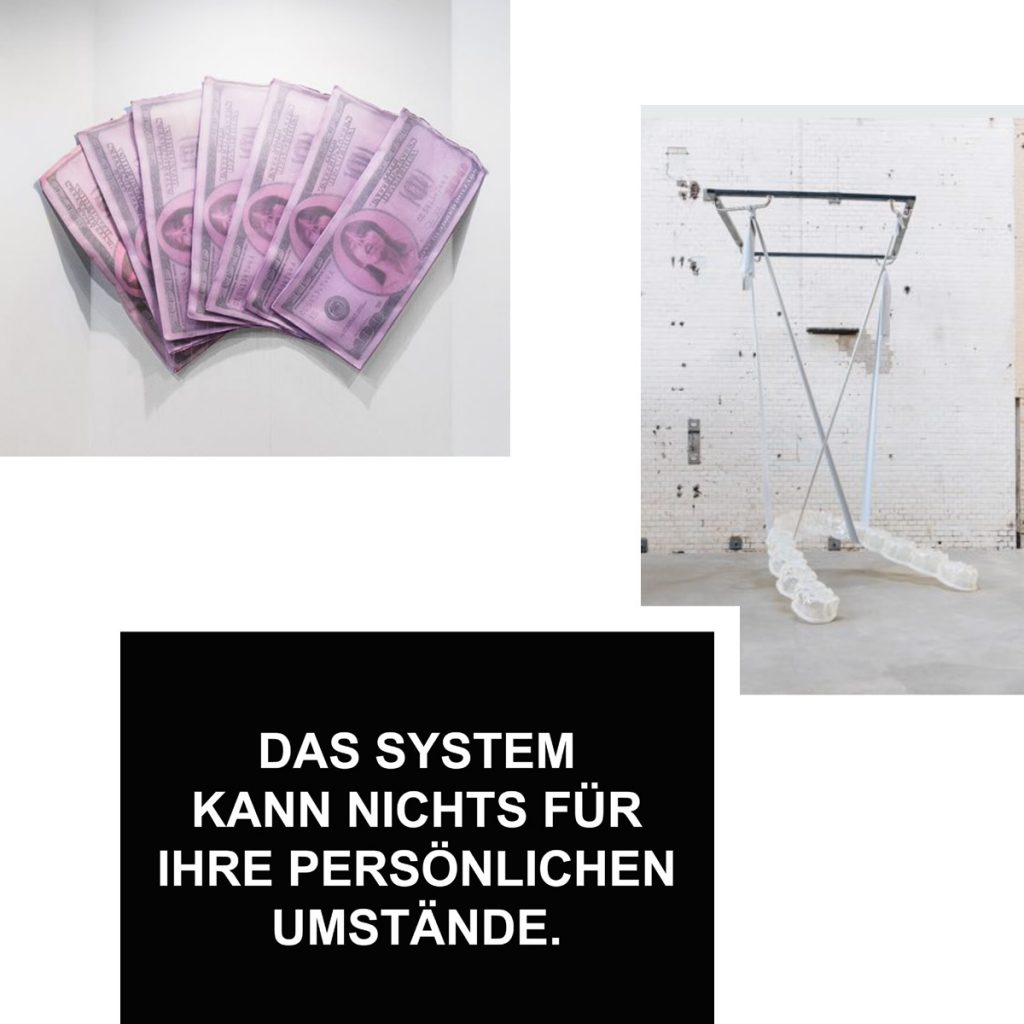
Money makes the world go round, especially in art. Very few artists are able to make a living from their art alone. Mediocre day jobs are often the only financial support for artistic practice. At the same time, the art world can feel like a bubble where everyone seems to have money. Amid dwindling funding across Berlin’s cultural landscape, Julie Legouez and Evelina Reiter are opening the next edition of their exhibition series Fight or Flight tonight (12.06.2025). The theme is money. 33 FINT* (women, inter, non-binary and trans) artists will present their work. “Fight or flight” is a term from biology that describes the body’s stress response in dangerous situations. It prepares us to react by fighting the threat or fleeing from it. For the two curators, it’s a broader metaphor for the stress many people carry: especially women*, artists, and anyone living with systemic pressure. That’s why they invite a lot of people to their shows. After all, networks don’t form on their own, they have to be built.

In 2022, Julie Legouez started an exhibition by inviting five artists from her network and five strangers via Instagram. One of them was Evelina Reiter. That exchange became a collaboration, and today, they curate together through open calls. An Exhibition About Money is the second in the series. Last year’s debut focused on fear — and few shows have left such a lasting emotional impression. I saw too much of myself in works about panic walking home at night, partner violence, and catcalling. This time, too, it’s about lived realities: poverty and social background, side jobs and the frustration of applying for support, the gender pay gap, family roles, classism, psychological strain, rent, subsidies, fear, and anger. Just like last time, a strong supporting program is even more reason to visit — from a K-Pop concert with Mizi Lee to workshops, readings, and an auction on 19.06. (bring cash). Let’s talk about money.

Text: Inga Krumme / Credit: Karo Kuchar, Kunstdokumentation; Dana Lorenz, VG Bild-Kunst Bonn; Julie Legouez, VG Bild-Kunst Bonn

Stadtwerkstatt Friedrichshain-Kreuzberg, Mehringdamm 20, 10961 Berlin–Kreuzberg; map

@fightorflight.berlin

cee_cee_logo
ART YOU CAN ACTUALLY AFFORD — BERLIN’S AFFORDABLE ART FAIR

ART YOU CAN ACTUALLY AFFORD — BERLIN’S AFFORDABLE ART FAIR

Good art doesn’t have to be unaffordable. The Affordable Art Fair proves this. From 13–15.06.2025, the art fair will move into Arena Berlin for the second time. Contemporary art priced between 100 and 10,000 euros from over 60 galleries across 19 countries will be on display. Artists include exciting newcomers, Berlin talents, and established names. There will be a dedicated wall for art that’s under 1,000 euros, free guided tours, and a special exhibition for up-and-coming artists titled Emerging Artists Berlin 2025. Among the promising names: Paula Hoffmann works with wonderfully spatial textiles; Anne Meerpohl’s water-colored forms float between corporeal and fluid; and Penny Monogiou explores motifs from ancient Greece, identity, and ideals of beauty in her mixed media paintings. What’s particularly special this year is that the Affordable Art Fair extends to the water. On the first two evenings, the Badeschiff — with its outdoor pool and beach bar — becomes part of the event. Tonight (12.06.), the fair opens with a festive vernissage — a perfect evening to stroll through the fair at your leisure, meet the artists at the Badeschiff, and toast to art (and summer) with a drink. The Late View with DJ Levente and cold drinks follows tomorrow (13.06.) — ideal if you prefer discovering art to a beat or want to avoid weekend crowds. bring curiosity, sunscreen, and an art collector’s eye. The rest will follow.

Text: Inga Krumme / Photos: David Reineke

Affordable Art Fair, Arena Berlin, Eichenstr.4, 12435 Berlin–Treptow-Köpenick; map

Click here for the tickets.

cee_cee_logo
ONE MORE ROUND OF GORKI — THE FINAL WEEKS BEFORE THE SUMMER BREAK

ONE MORE ROUND OF GORKI — THE FINAL WEEKS BEFORE THE SUMMER BREAK

In the last few weeks before the summer break and the imminent departure of artistic director Shermin Langhoff, the Maxim Gorki Theater is once again showing how lively and relevant theater can be, with current topics and productions. Despite the cultural cutbacks, many of Berlin’s theatres are stepping into the spotlight. (Perhaps because we no longer take them for granted.) One of them is the Gorki in Mitte, a theater that has changed dramatically over the last ten years under Shermin Langhoff. Now her directorship is coming to an end. Anyone who would like to get another impression of this special style will have the opportunity to do so in June and July. The program remains varied. Classics such as Franz Kafka’s The Trial (directed by Oliver Frljić, on 01. and 08.07.) meet new works such as KIM, a solo performance by Nairi Hadodo about pop culture, identity, and female self-empowerment, inspired by Kim Kardashian. On 10.07, Dschinnscelebrates its 50th performance. Nurkan Erpulat’s production is based on the novel by Fatma Aydemir and tells a multi-layered family drama between Germany and Turkey. Anyone who has not yet seen the play should take the opportunity to do so. It also continues at Studio R, where Lena Brasch will be showing her new play Brasch – Das Alte geht nicht und das Neue auch nicht. A personal, musical homage to her uncle Thomas Brasch, and a clever commentary on the current state of culture.

Text: Hilka Dirks / Photos: Ute Langkafel Maifoto

Maxim Gorki Theater, Am Festungsgraben 2, 10117 Berlin–Mitte; map

You can find the full program until the summer break here.

@maxim_gorki_theater

cee_cee_logo