
Cee Cee Creative Newsletter Book Neighborhood Map Lessons
Stadtplan
Information
archive temp
loop temp
DER ERSTE FIESE TYP — A THEATRE EVENING SOMEWHERE BETWEEN SELF-CONTROL & EMOTIONAL CHAOS

DER ERSTE FIESE TYP — A THEATRE EVENING SOMEWHERE BETWEEN SELF-CONTROL & EMOTIONAL CHAOS

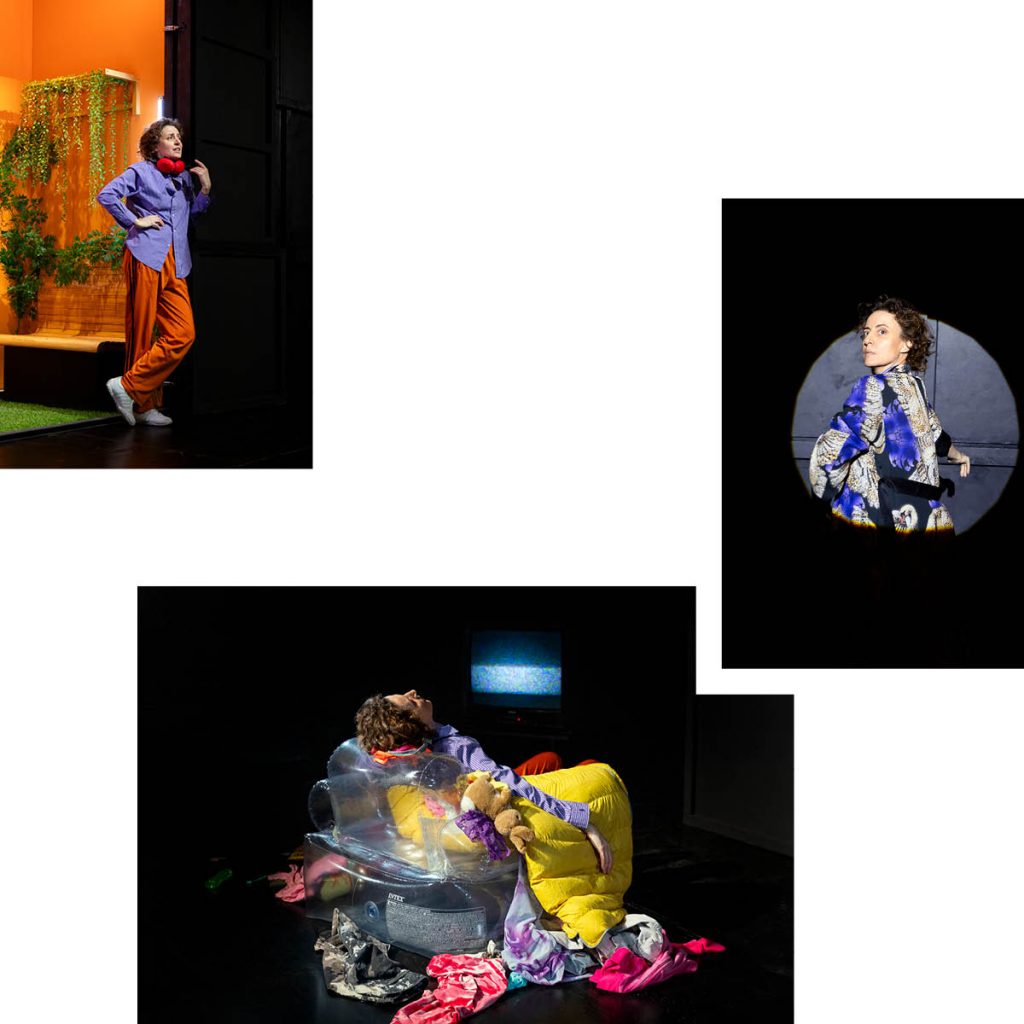
Have you really never heard of Miranda July? Maren Eggert doesn’t ring a bell? If that’s the case, you must urgently get a ticket to Der erste fiese Typ (The First Bad Man) at the Deutsches Theater Berlin. Based on the novel by American author and artist Miranda July, the play features none other than Maren Eggert (in my opinion, one of the most exciting actresses in the German film and theatre landscape). The evening, at the Deutsches Theater, unfolds as an absurdly funny and wonderfully offbeat monologue about relationships. Maren Eggert plays Cheryl, a woman in her early forties who believes she has perfectly organized her life through self-invented rules, maximum self-control, and a very active imagination. That is, until she ends up trapped by her own system. Director Sarah Kurze stages the material as a monologue, opening up Cheryl’s inner world, somewhere between comedy and melancholy. Behind the protagonist’s seemingly well-ordered surface lies emotional emptiness and a deep uncertainty about how closeness between people actually comes into being. How do we begin to let others in? Her own logic and order are everything to her. No unnecessary routes through the house, meals eaten straight from the pan, and books read directly in front of the shelf. Yet her perfectly organized life is thrown thoroughly off balance when the much younger, unapologetically unconventional Clee moves in — an encounter that challenges Cheryl’s entire way of life. Between self-defense videos, daydreams, and emotional chaos, Cheryl has to ask herself whether she may have completely misread the world – and herself. For 105 minutes, Maren Eggert moves between earnestness and laconic irony. It is gloriously quirky, at times absurd to watch, and deeply intelligent. A true acting tour de force that carries the entire evening. Chapeau! The result is a clever and funny, surprisingly tender night at the theatre about self-protection, self-determination, projections, and the moment when fantasy collides with reality.

Text: Milena Kalojanov / Photos: Jasmin Schuller

Deutsches Theater, Schumannstr.13a, 10117 Berlin–Mitte; map
Der erste fiese Typ (The First Bad Man). Find tickets for April 2026 online.

@deutschestheater

cee_cee_logo
FRENZIED DIALOGUES BENEATH A BLAZING SUN: KINDER DER SONNE AT THE BERLINER ENSEMBLE

FRENZIED DIALOGUES BENEATH A BLAZING SUN: KINDER DER SONNE AT THE BERLINER ENSEMBLE

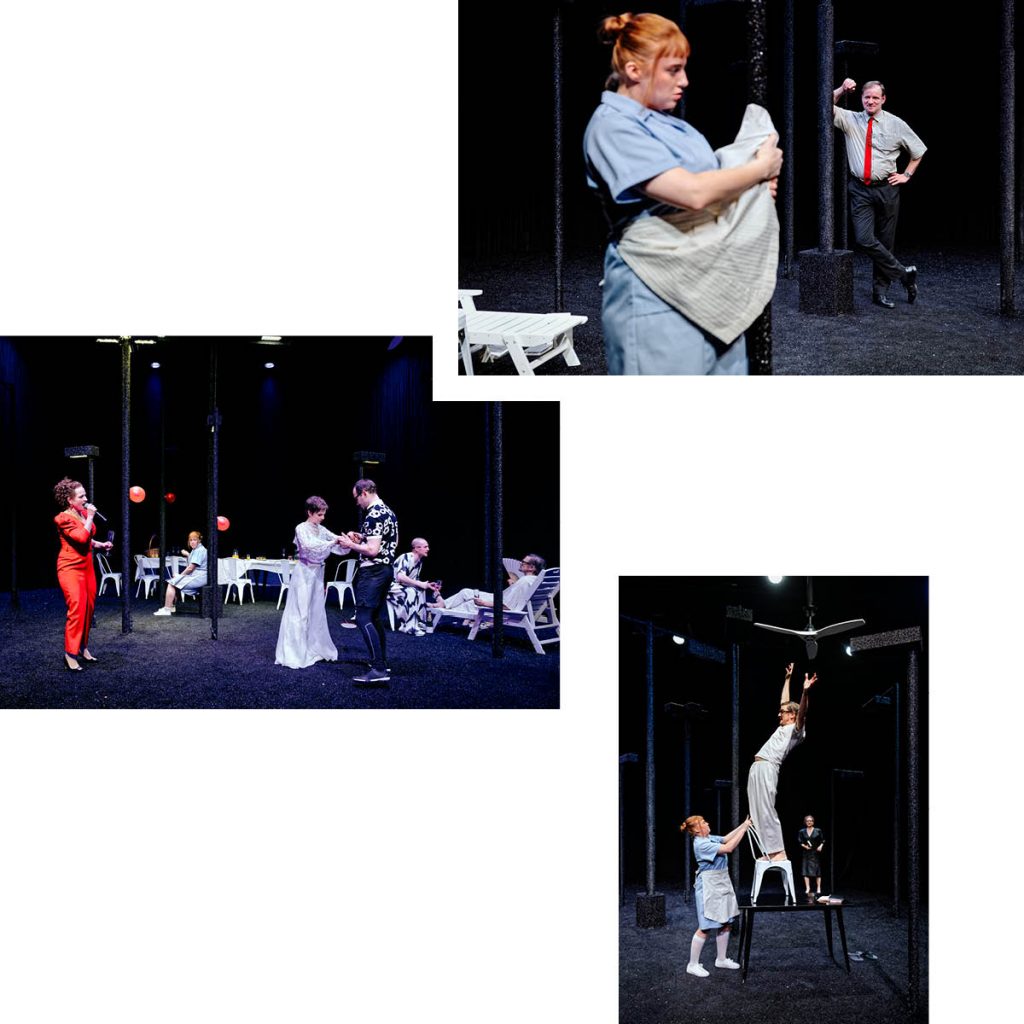
Director Laura Linnenbaum stages Jakob Nolte’s contemporary adaptation of Maxim Gorki’s Kinder der Sonne (“Children of the Sun”) as a two-and-a-half-hour dense milieu study of a bourgeois society running on empty. In doing so, the production comes alarmingly close to the present day. The first thing you notice is the floor. Sticky, glittering black, it covers the entire stage of the Neues Haus. It creeps up the lampposts and transforms the garden of a villa on the outskirts of town into a place you would rather not touch, somewhere between an oil spill, rare earth, and burnt asphalt. Whatever stage designer Daniel Roskamp has laid down forces the characters to keep moving, as if standing still on this hostile surface was painful. The protagonists keep slipping and sliding, much like the words that tumble unchecked from their mouths. Three intellectuals, a literary scholar, his wife, and his traumatized sister, live in a house with a perpetually broken garden gate. They are courted by a businesswoman, a painter, and a veterinarian. Meanwhile, the housekeeper, a craftsman, and the landlord remain at the margins, often literally. Everyone talks with each other, against each other, mostly past each other. No one is particularly likable. They are all antiheroes. And yet you find yourself involuntarily caught up as the drama unfolds. It is not easy to surrender to the play right away. The double strain of staged and real reality weighs heavily. But once you allow yourself to become immersed, you suddenly find yourself in the middle of a frenzied linguistic maelstrom about the relevance and futility of the educated bourgeoisie. What remains is an exceptionally sharp character study of an educated society, without moral judgment.

Text: Hilka Dirks / Photos: Gianmarco Bresadola

Berliner Ensemble, Bertolt-Brecht-Platz 1, 10117 Berlin–Mitte; map

Kinder der Sonne (Children of the Sun) until 26.04.2026

@blnensemble

cee_cee_logo
IN ITS NATURAL HABITAT: KW PRESENTS KLARA LIDÉN, JEAN KATAMBAYI MUKENDI & ELSE MARIE PADE

IN ITS NATURAL HABITAT: KW PRESENTS KLARA LIDÉN, JEAN KATAMBAYI MUKENDI & ELSE MARIE PADE

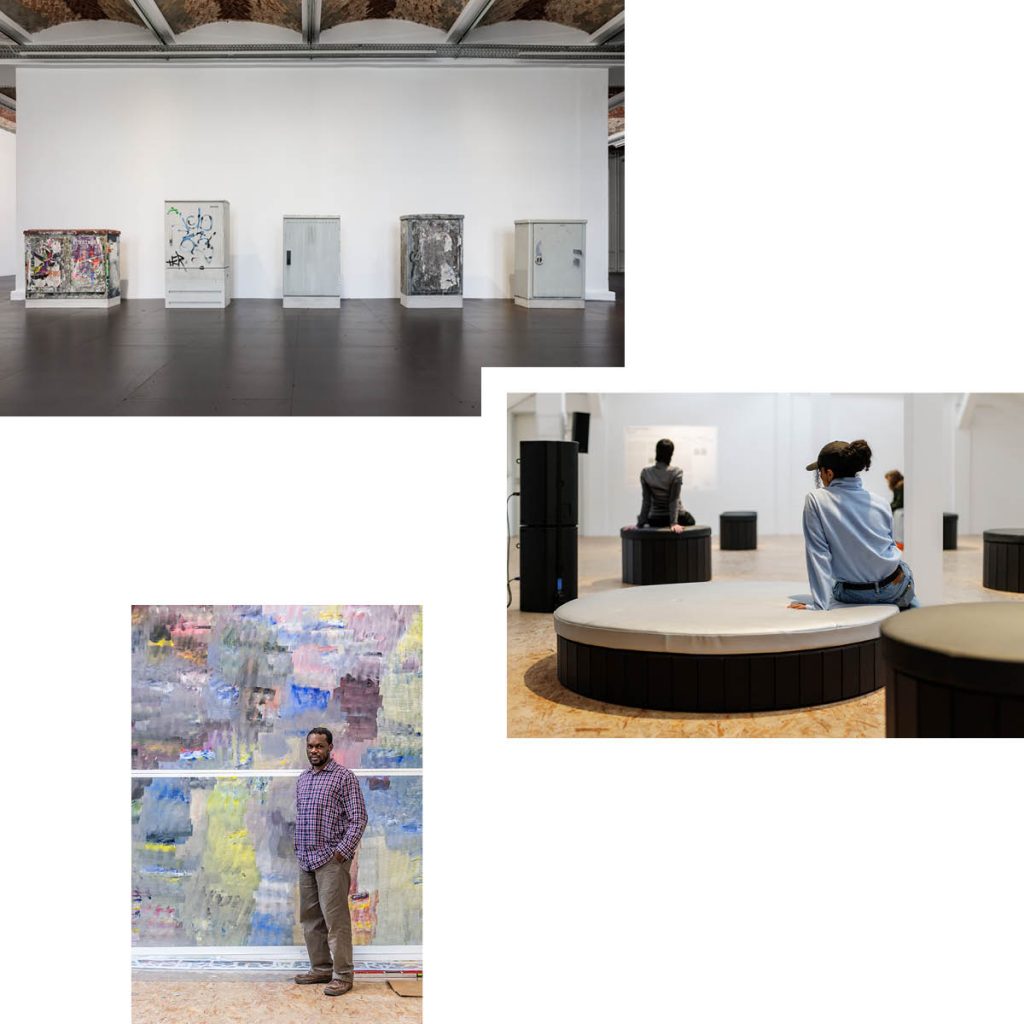
Who owns public spaces? If you ask KW Institute for Contemporary Art, the answer is unequivocal: the artist Klara Lidén. As the title of one of her earliest 2005 self-portraits declares, she holds the “Keys to the City”. In the photograph, Lidén conspiratorially opens her trench coat in a playful black-market pose. Lining the inside are bolt cutters, pliers, and wrenches — the tools with which she uses to unlock cities to this day. Equipped as such, she launched her campaign of conquest from the streets of Stockholm, New York, and Berlin into galleries and museums around the world. The urban space remains both Lidén’s stage and her material depot. Her sculptures, performances, photographs, and video works emerge directly on sidewalks, in trains, underpasses, and parks. In doing so, she disrupts the anonymity and cosmopolitan codes of conduct in big cities. By exploring urban centers out to their margins and beyond the barriers, she reveals that even in places promising the greatest freedoms, boundaries and power hierarchies persist. Thanks to KW, the city she has called home for the past twenty years is finally dedicating its first institutional solo exhibition to her. Spanning three floors, the retrospective brings together subversive works from the past two decades. Often disorienting, yet always humorous, Lidén embarks on a reclamation of urban space. Drawing on her background in architecture, she refers to this practice as “Unbuilding” — a strategy that can take many forms: at times she performs, as in “Paralyzed” from the early 2000s, a pole-dance routine for commuters on the S-Bahn. At others, she dismantles trash bins and advertising boards from pedestrian zones and reassembles them as readymades in the white cube.

Lidén’s practice borrows from the improvised street aesthetics of punk and graffiti, while casually drawing on intellectual heavyweights such as Guy Debord, Marcel Duchamp, and the Affichistes. At a time when anonymous investors are buying up inner cities and allowing them to decay into ghost blocks, she tirelessly fights for what makes metropolises truly unique and livable at their core: their open spaces. Working with found materials from public space, too, is the Congolese artist Jean Katambayi Mukendi. The trained electrician spent last autumn as an artist-in-residence at KW Institute for Contemporary Art. Using discarded items from the KW’s storage and materials sourced from Berlin recycling centers, he transformed scrap into playful sculptures that have shed any trace of their original functionality. His imaginative constructions can be read as metaphors for inequality in his homeland, the Democratic Republic of the Congo. Translating an entire urban landscape — with all its hierarchies — into sound was the achievement of Else Marie Pade. KW dedicates a sensitive audio exhibition to the Danish composer, techno pioneer, and resistance fighter: ten of her most significant musical arrangements, alongside works on paper, introduce the Musique concrète pioneer, who passed away in 2016, to a wider public for the first time. Her “Symphonie magnétophonique” evokes 24 hours in Copenhagen through an intricate sonic tableau. If Klara Lidén is the keeper of the city’s keys, then Else Marie Pade was the guardian of its urban sound. Both shared a clear message: ultimately, urban space belongs not to the powerful, but to the people.

Text: Laura Storfner / Photos: David von Becker, Frank Sperling

KW Institute for Contemporary Art, Auguststr.69, 10117 Berlin-Mitte; map
Klara Lidén: Kunstwerke until 10.05.2026
Jean Katambayi Mukendi: Ratio until 10.05.2026
Else Marie Pade: Partitur until 10.05.2026

@kwinstituteofcontemporaryart

cee_cee_logo
30 YEARS OF THE PRESENT: HAMBURGER BAHNHNHOF LAUNCHES ITS ANNIVERSARY YEAR WITH PAINTINGS IN PAYNE’S GREY

30 YEARS OF THE PRESENT: HAMBURGER BAHNHNHOF LAUNCHES ITS ANNIVERSARY YEAR WITH PAINTINGS IN PAYNE’S GREY

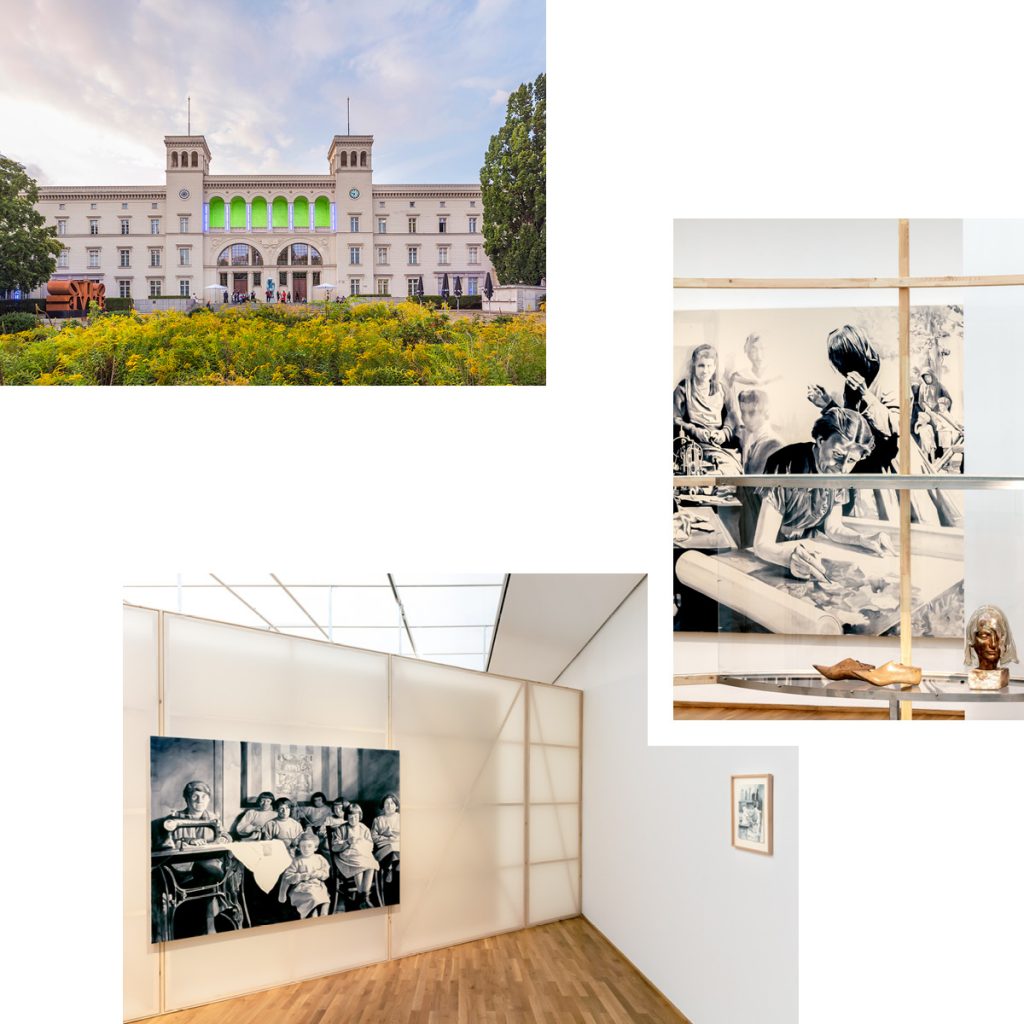
The next institution is celebrating a milestone: Hamburger Bahnhof is turning 30 and marking the occasion with a comprehensive year-long program. In 2026, everything revolves around exchange, participation, and the question of what a museum can be today. Eight new exhibitions, performances in public spaces, concerts, and conferences will take the institution further into the city. Giulia Andreani (27.02.–13.09.2026) opens the anniversary year with her first institutional solo exhibition in Germany. For the occasion, she’s developed new paintings that enter dialogue with Berlin collections — antiquities, decorative arts, European cultures, and the Kupferstichkabinett. Andreani’s artistic practice is shaped by the tension between authoritarian figures and forgotten protagonists of the past. Her monochrome paintings draw on family albums and archival material. Rather than quoting history, she reexamines it. It’s a thoughtful start to the anniversary year. The opening takes place today, 26.02.2026, at 19h. Admission is free. This will be followed by exhibitions featuring Shilpa Gupta, Lina Lapelytė, Ryuichi Sakamoto, and Sophie Calle, as well as a group exhibition by the Leipzig collective materialistin and a reunion with artists who once had studios in the Rieckhallen, including Tacita Dean, Thomas Demand, Olafur Eliasson, Henrik Håkansson, and Tomás Saraceno. In June, a new collection presentation will be added, focusing on Berlin since 1989 in global dialogue. The finale in November will be an international conference on the future of collection-based museums, accompanied by 30 consecutive hours of opening time. An anniversary that looks ahead.

Text: Inga Krumme / Photos: David von Becker, Laura Fiorio / Credit: Giulia Andreani. Sabotage; Staatliche Museen zu Berlin, Hamburger Bahnhof – Nationalgalerie der Gegenwart; VG Bild-Kunst, Bonn 2026, Staatliche Museen zu Berlin

Hamburger Bahnhof, Invalidenstr.50, 10557 Berlin–Mitte; map
Giulia Andreani 27.02.–13.09.2026

@hamburger_bahnhof

cee_cee_logo
A FINAL TURN — “DIE GEWEHRE DER FRAU KATHRIN ANGERER” AT THE VOLKSBÜHNE

A FINAL TURN — “DIE GEWEHRE DER FRAU KATHRIN ANGERER” AT THE VOLKSBÜHNE

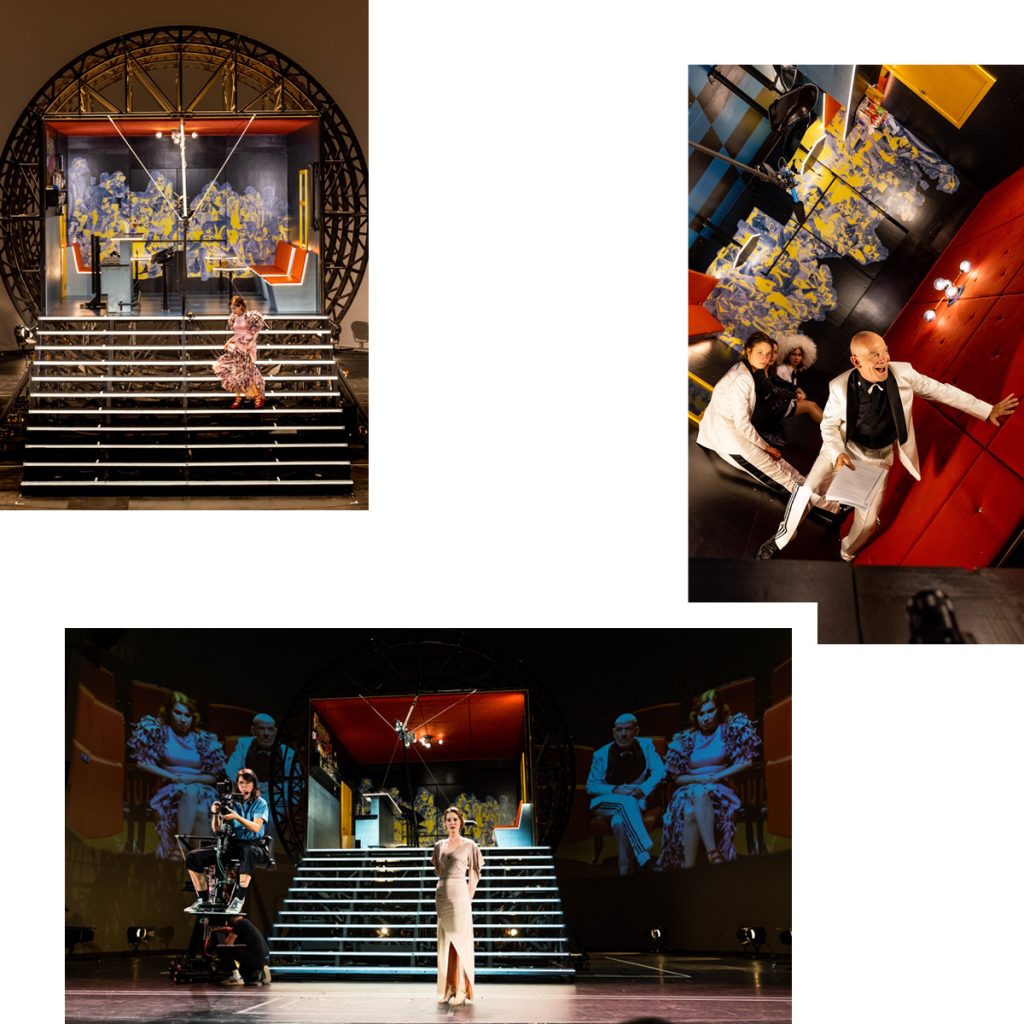
Everything is spinning. The boards beneath the performers’ feet, the audience orbiting the grand spectacle, the theatre circling itself. Or is this simply a dance film in the making? On 04. and 05.03.2026, “Die Gewehre der Frau Kathrin Angerer” by René Pollesch returns once more to the Volksbühne stage, a co-production with the Wiener Festwochen. And perhaps that is precisely why it feels so right to begin at rock bottom. There is no slow ascent toward a grand, tragic finale. Instead, the opening drops its characters, and us, first and foremost, straight into the fractures and minor catastrophes of their lives. Old love, failed plans, moments that are at once comic, sharp, and broken. And then the stage revolves. Literally. The award-winning set design by Nina von Mechow features a monumental reproduction of Monolith by Alekos Hofstetter, becoming the backdrop for a glorious tangle of references: Hollywood clichés, the Spanish Civil War, Bertolt Brecht himself, and choreographed fistfights. The desire intensifies to figure out what is real and what is performed, and what remains when theatre revolves around itself. On stage: Kathrin Angerer, Benny Claessens, Josefin Fischer, Lilith Krause, Rosa Lembeck, Marie Rosa Tietjen, and Martin Wuttke, joined by a seven-member dance chorus from the youth company of the motion*s Tanz- und Bewegungsstudio. If you’d like to plunge once more into this heady mix of movement, text, comedy, and gravity, you have two more evenings to do so.

Text: Emma Zylla / Photos: Luna Zscharnt

Volksbühne, Linienstr.227, 10178 Berlin–Mitte; map
Die Gewehre der Frau Kathrin Angerer 04.03.2026 20h and 05.03.2026 19h30. Get tickets here.

@volksbuehne_berlin

cee_cee_logo